
Billy O's Blog

“Liberty means responsibility. That is why most men dread it.”
Click Preview at bottom of the page to see more blog posts
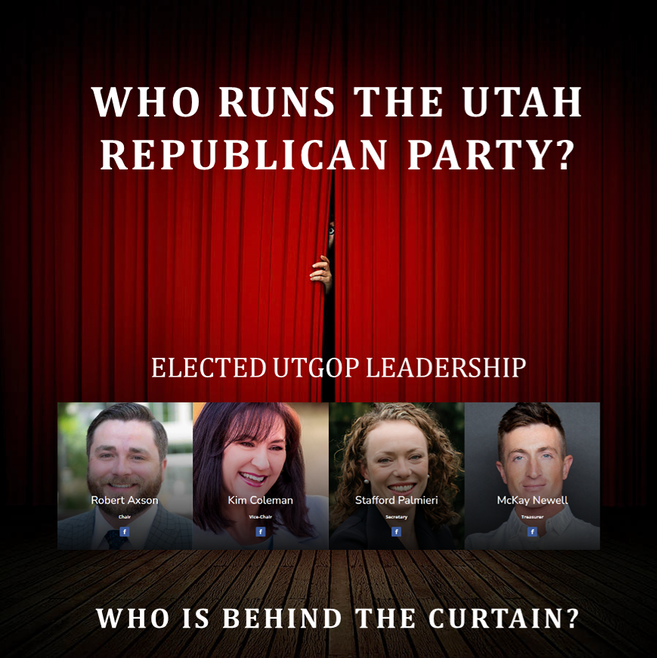 ONE FOR ALL...ALL FOR ONE!
The Utah Republican Party State Convention: Saturday, April 27, 2024 My Convention Report Bill Olson NOG12 Weber County _______________________________________________ After spending an hour and a half in line to register as a delegate, I entered the convention hall to find a seat. The hall was full of delegates of which almost half raised their hands as first-time delegates. Shortly after the prayer, pledge of allegiance, approval of the rules and the agenda we got started. I was standing at the microphone waiting for my turn as a delegate to gain the floor as a member of our deliberative assembly represented by all 29 counties in Utah. As a deliberative assembly, our state delegates meet at our state convention to determine, in full and free discussion, the election of our state candidates and courses of action to be taken by our Party. To hold more efficient meetings and respect the opinion of each member, we adhere to the rules of parliamentary procedure. We are there to exhaust all debate before any vote is taken or decisions are made. Debate cannot be exhausted if it is restrained and that is what happened here today. Prior to the Convention there were many of us delegates concerned about the direction of the Party and its leadership. Since the success of SB 54 our caucus/convention system has been essentially neutered. This unconstitutional legislation forced on the Party by big money interests has created a path to getting their candidates elected without the hassle of delegate scrutiny or Party endorsement. With the deterioration of election integrity over the last few election cycles, many in the Party have related concerns about the method of elections at our Convention. The State Central Committee (SCC) is the Policy making body of the Party. Members are elected by every county; these committee members operate as the legislative branch of the Party with the responsibility of governing the Party as a deliberative assembly. That means they make the rules by majority or in some cases a super majority using Roberts Rules of Order. Roberts Rules allows for the majority to rule while acknowledging the rights of the minority. Under these rules, the SCC determines how the Party business is conducted. Prior to our Convention there was concern by many delegates and members of the Party that Leadership, the executive branch of the Party, tasked with executing the will of the governing body, was scheming to use an electronic voting system rather than paper ballots as decided by the SCC. It seems there are members of the Party with commercial interests in promoting their electronic voting services (https://www.innogov.io/) who have achieved leadership positions in certain Convention Committees, the very committees who are tasked with executing the policies of the SCC. According to our Republican Party Constitution, these committees are “recommending bodies only.” So why then do they make decisions in direct opposition to the SCC? When it was discovered by a few of us that for this convention, Party leadership had no intention of securing election integrity by executing on the SCC’s call for Paper Ballots, many state delegates objected. Several months before the convention, we pushed the Party to play by the rules and a petition was generated and signed by over 400 state delegates in less than 10 days directing Party leadership to use paper ballots as determined by the SCC. (https://docs.google.com/spreadsheets/d/1lkzSmiEl8OFwTSO8aVSWjtkqjeMBvcfb5OYMBiI4B-o/edit#gid=841220358). To “protect the vote” Paper Ballots are also recommended by the Republican National Committee (RNC). “The Republican National Committee boldly opposes means of voting that do not have the proper safeguards in place and are exclusively electronic and calls on every county and state in the nation to use as the default ballot systems, which are fully auditable, namely hand-marked, voter-verified paper ballots to ensure every voter is memorialized by a paper record;” Electronic voting is not secure and personal information is at risk. Once exposed, leadership, rather than follow the directive from the SCC to use paper ballots, moved away from the conflict of interest using certain committee members commercial product, to another electronic voting system called Election Buddy (in the ironies of ironies, even Election Buddy supports Paper Ballots (https://ripl.se/uB). This voting system uses an application that allows you to scan with your phone to vote. The problem is this scan allows for the service to capture the data on your phone and according to their Privacy Policy, use it as directed by the UTGOP for their own commercial benefit (https://electionbuddy.com/privacy-policy/). Have you ever looked at a website on your phone and several days later you walk by a service similar to the one you were looking at and just like that, their ad appears on your phone? Party leadership has a special purpose in infiltrating your phone...they want to use technology to profile you and make money from the profile information gathered without your active knowledge. On the agenda was also an amendment to change the current public record requirement in our Constitution that provides “at a minimum, the name address and phone number” of all party elected positions and instead the amendment seeks to redact all contact information except your name. Should this pass, our Weber County Conservatives patriot training will cease! All data will be controlled by the Party and sold or provided only to those the Party chooses. Couple this with their retrieval of all your personal information on your phone and they will control it all and you will have nothing. Back to the microphone where I was waiting patiently. As the Elections Committee Chairman took the podium to start the process of forcing the delegates to use their electronic voting service, I called out a Point of Order. Once I was acknowledged by the Chair, I HAD THE FLOOR WHICH MEANS I CANNOT BE INTERRUPTED! A Point of Order is a parliamentarian move that can interrupt the speaker…it is used if a member feels the rules are not being followed. It requires the chair to make a ruling and enforce the rules. If he makes a ruling, you do not think is fair, you may challenge the ruling of the Chair and let the delegates decide by a vote. The delegates have the power...unless they give it up to the Chair...which is what they did here at convention. Because the body of the deliberative assembly (delegates) has the power, and the Chair is merely a facilitator of the assembly (he doesn’t’ even get to vote unless to make or break a tie). The delegates make all decisions. The Chair is there to share opinions, but any ruling of the Chair can be challenged. Once challenged, the delegates get to vote as to whether the Chair decision is overruled. Receiving much applause, my Point of Order asked a simple question... by what authority does the Elections Committee, a recommending body only, have to overrule the SCC, the governing body of the Party and foist this electronic voting on the delegates? The Chair ignored my Point of Order, a violation of Roberts Rules, and said he would get to it later, allowing the Committee Chairman to continue to instruct the delegates on how to use the electronic voting system. The Parliamentarian, there to assist both the Chair and the delegates to properly follow our rules, was silent (a violation of her own certification ethics). My persistence in having my Point of Order properly dealt with resulted in the Chair claiming he was not bound by the SCC vote to use paper ballots and proceeded to sit down. While asking the Chair if this was his decision, my microphone was turned off! I had every right as a privileged member of the assembly to challenge the ruling of the Chair and let the delegates decide whether we followed the SCC or allow a recommending body only to dictate how the elections were to be conducted. Done properly, this issue could have been dealt with in a few short minutes with the delegates deciding whether to ignore their own rules or not. Without sound, I stood there waving the microphone to get the attention of the parliamentarian and the Chair to acknowledge my rights as a delegate to speak. After all, I HAD THE FLOOR! Being completely ignored by the Chair...I dropped the microphone to the ground and promptly left the convention embarrassed for the delegates who do not understand their role in this process and angry at Party leadership for exploiting their ignorance. For the last two years, Weber County Conservatives has offered training for all elected positions in the Party including delegates to understand their roles and responsibilities. Disrespecting the rights of one delegate is disrespecting the rights of all delegates. The delegates’ silence, as my rights were trampled on, only adds gasoline to the fire of the tyranny in our government and our Party. This behavior by the Party leadership begs the question, who is in charge? Why are the rights of the assembly and the delegates involved not respected in order to conduct our convention procedures? The Party leadership’s inability to follow our governing rules is unacceptable and outrageous! Will you, as a member of the assembly, do anything about it?
5 Comments
How the Left Fooled States Into Boosting Democratic Turnout—and How to Stop ItBY Hayden Ludwig
In elections, good data separates the winners from the losers. Left-wing operatives understand this better than anyone, which is why they’ve built the world’s most impressive machine to find, register, and turn out their preferred voters—all using tax-exempt nonprofits created to encourage charity, not politics. Activists label it “civic participation” because they’re benignly registering people to vote. In reality, they’re cynically helping just Democrats vote. Conservatives have witnessed the awesome power of this election machine in states like Georgia and Arizona. But there’s one component they’ve yet to reckon with: the Electronic Registration Information Center, better known as “ERIC.” ERIC is a 501(c)(3) public charity, not a government agency; yet this privately run organization has incredible access to sensitive information on 208 million Americans—62 percent of the total population—across 31 states. ERIC claims it uses this data strictly to help its member states maintain clean voter rolls by tracking when voters move, die, or fall off the registration list. The more states that join the compact, the theory goes, the more accurately ERIC can funnel information to them. Yet shocking new discoveries about the compact’s origins reveal ERIC’s true purpose: Compiling a near-perfect picture of where America’s voters—and potential voters—live nationwide, driving Democratic victories in battleground states. Amazingly, ERIC’s membership agreement forces states to conduct expensive voter registration campaigns, yet does not require states to clean their voter rolls, the very reason most states enrolled in the compact. This is ERIC’s value to the Left, the best data money can’t buy.
How the Left Fooled States Into Boosting Democratic Turnout—and How to Stop ItERIC’s Data-Driven Origins Yet all this microtargeting machinery is only as good as the voter files that inform it. Critically, while Catalist and others could purchase those voter files, no such list of unregistered people exists. State motor vehicle departments and other agencies collect vital information on potential voters, but that data is inaccessible to companies under federal privacy laws. Worse, the most desirable demographic—young people—typically have no credit history or utilities in their name, making them virtually invisible to political data vendors. What was needed to reach this electoral goldmine was a central database on all 65 million eligible-but-unregistered individuals, but that was impossible with traditional data-collecting methods. Enter ERIC. ERIC began life in 2012 as a project of the Pew Center on the States (an arm of the liberal funder Pew Charitable Trusts) under David Becker, Pew’s director of election initiatives. If the goal was to get states to share valuable voter data with a private organization, ERIC needed a powerful selling point and the guise of political neutrality. So for the next four years Becker led the push to lobby nearly two-thirds of the states into joining ERIC—always marketing it as an opportunity to improve their voter rolls more effectively and affordably than they could do themselves. Early ERIC funding came from George Soros’s Foundation to Promote Open Society, which granted $725,000 in 2011 “to support the Pew Center on the States’ voter registration modernization initiative” and “expand [its] scope and scale.” The idea for ERIC may even have originated with Soros, who after all had previously helped found the Democrats’ premier data firm, Catalist. In 2010, Soros’ Open Society Foundations (OSF) revealed its goal of using voter registration “modernization” programs as cover to convince states they needed outside help to maintain their voter rolls. OSF termed it “reform dialogue.” OSF rallied two more left-wing organizations to the cause: the Brennan Center and Advancement Project, both of which oppose voter ID laws and lobby for the Left’s usual raft of election “reforms” such as same-day registration and felon re-enfranchisement. (Recall that the Brennan Center had already called for mass voter registration campaigns “through a modernized registration system” to advance the “progressive agenda” beginning in 2010.) 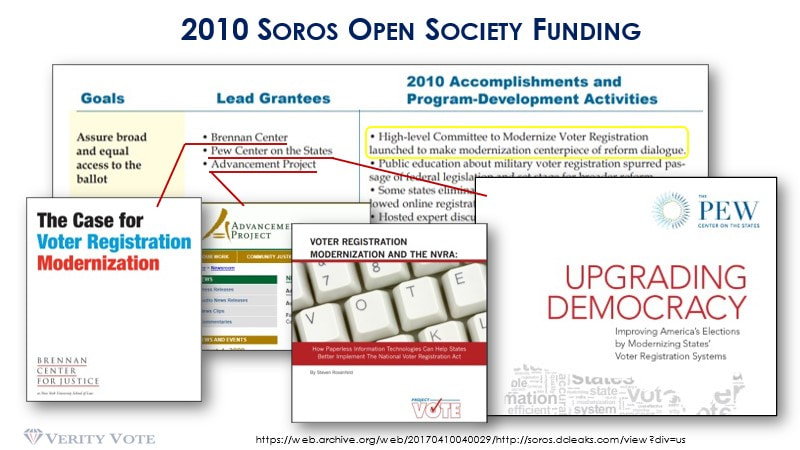 Credit: Verity Vote, 2022. UTAH SHERIFFS MESSAGE TO CANDIDATES FOR HIGH OFFICE: STOP DEMAGOGUING ISSUES YOU DON’T UNDERSTAND4/4/2024  “Any candidate blaming local officials for the failures of the U.S. Immigration and Customs Enforcement is demonstrating to voters that they don’t understand important issues facing our state and country,” said Sheriff Mike Smith, President of the Utah Sheriffs’ Association.
“It’s bizarre that Republican candidates for high office would keep repeating false statements that have been walked back by the Biden Administration,” Smith continued. “It’s even more bizarre that candidates in Utah would malign local law enforcement without first knowing the facts.” Background Last year, a draft memo was put out by ICE’s Salt Lake City Field Office Director Michael Bernacke titled “Sanctuary State Designation for the State of Utah”. In this memo, Bernacke took it upon himself to declare Utah a sanctuary state. He made absurd claims that Utah sheriffs are destabilizing ICE’s law enforcement capabilities in Utah and surrounding states. State leaders joined Utah’s sheriffs in voicing strong objection, and ICE immediately rescinded the draft memo. Historically, not all sheriffs in Utah have been willing or able to house federal detainees in county jails. Those who did contract with ICE have been subjected to unending federal mandates, regulations that are not based upon constitutional rights, legal standards not based on case law, and demands that ICE detainees receive special treatment far exceeding what incarcerated U.S. citizens receive. The demand that ICE detainees receive special privileges is accompanied by audits and threats of lawsuits from liberal Washington DC based special interest groups. The ICE policies and practices under the Biden Administration have made it impossible for Utah’s sheriffs to house their civil detainees. Now some candidates for office are openly citing the rescinded ICE memo and demagoguing on the issue using false information. As the election year continues and the political season heats up, Utah’s sheriffs respectfully request that candidates running for office at least reach out and ask a sheriff before taking positions and issuing statements that are directly related to the work they do.  By Otto Krauss There has been some news lately about the Electronic Registration Information Center (ERIC) and what it does, but mostly because a number of states have cut ties with the organization in the last year. Why is ERIC significant and why should Utahns care about this organization?  David Becker - Controled 200 million voter registrations in the US. David Becker - Controled 200 million voter registrations in the US. ERIC was founded as a non-profit in 2012 by the Pew Charitable Trusts under the direction of David Becker. The organization collects voter data from participating states and purports to help maintain voter registration rolls. The stated mission is to “help states improve the accuracy of America’s voter rolls, increase access to voter registration for all eligible citizens, reduce election costs, and increase efficiencies in elections”. Utah, along with Colorado, Washington, Nevada, Virginia, Maryland, and Delaware were founding member states. Membership grew to 32 states in February 2023 and then quickly shrunk as 9 states left (so far) after discovering the ulterior motives of ERIC.
ERIC member states pay an initial $25,000 fee upon joining, and annual dues are between $26,000 and $116,000, depending upon the state’s population. As an example, Utah paid $49,000 for 2023. The arrangement between member states is to provide voter registration and DMV data to ERIC to help identify ineligible or inactive voters. ERIC claims to have found 2.5 million voters who moved across state lines, about 203,000 duplicate voter registrations, and about 65,000 deceased voters. Of these numbers, ERIC identified about 261,000 that moved out/into Utah, 27,000 duplicates, and 6,100 deceased. Encouraging voter registration is also a key focus of the organization, identifying more than 60 million unregistered voters (among member states alone). These goals are seemingly innocuous enough and in a way noble, encouraging people to participate in the voting process. The way these goals are achieved, is questionable however. The data that ERIC requests from the states is to be submitted every 60 days, while information regarding inaccurate voter registrations from ERIC to the member state is to be provided at most once a year. If a state fails to request it, ERIC will send it “automatically” after 425 days have elapsed. ERIC has no teeth with regard to enforcement of voter roll cleanup either. There’s no requirement for a state to actually remove the ineligible voters, only that they initiate contact with the voter in question within 90 days of receiving the data. So what is a member state to do with the data it receives from ERIC?  The Destruction of America is Happening Right in Front of Us!  "If I were the devil … If I were the Prince of Darkness, I’d want to engulf the whole world in darkness. And I’d have a third of its real estate, and four-fifths of its population, but I wouldn’t be happy until I had seized the ripest apple on the tree — Thee."  "So, I’d set about however necessary to take over the United States. I’d subvert the churches first — I’d begin with a campaign of whispers. With the wisdom of a serpent, I would whisper to you as I whispered to Eve: ‘Do as you please.’"  “To the young, I would whisper that ‘The Bible is a myth.’ I would convince them that man created God instead of the other way around. I would confide that what’s bad is good, and what’s good is ‘square.’ And the old, I would teach to pray, after me, ‘Our Father, which art in Washington…’"  “And then I’d get organized. I’d educate authors in how to make lurid literature exciting, so that anything else would appear dull and uninteresting." "WE OPPOSE ILLIGAL IMMIGRATION AND ALL FORMS OF AMNESTY, OR LEGAL STATUS, FOR ILLEGAL IMMIGRANTS"3/14/2024  The federal government’s failed policies and inability to protect our country’s border is causing upheaval and strain on states across the nation, including Utah. We are being forced to deal with the public safety, financial and humanitarian consequences of President Biden's failure to enforce immigration law. The result is that over two-thirds of captured illegal aliens are released back into our community here in Utah.
The Biden administration continues to make detention of illegal aliens difficult or impossible for local authorities to handle. Several federal agency's tactics are designed to discourage local jails from cooperating with U.S. Immigration and Customs Enforcement (ICE) threatening the public safety of all people living in Utah. ICE’s detention standards have become more absurd as a reaction to multiple lawsuits filed by many anti-enforcement groups. The Biden Administration’s response has been more stringent federal standards for ICE “detainees.” Whether intended or not, the consequences of these standards are that they cannot be met by our county jails.  Much has been said about how SB 54 and the signature gathering path has disrupted our Party’s ability to nominate candidates at our convention. What hasn’t been said is under these new election laws the Party is still in control of holding our convention and setting the parameters necessary to send a convention winner to the States Primary election. The Party makes that determination, constitutionally.
There is nothing in current election law that prohibits how a qualified political party determines its convention winner. And because the signature candidate is already in the Primary with an R behind their name, there is nothing that prohibits the Party from directing their delegates to consider a vote for a signature candidate as a wasted vote to determine the Party’s convention winner. The state runs elections, but we, the Republican Party of Utah, as a private constitutionally independent organization, run our political party and we alone determine how we qualify a convention winner for the state-run Primary. As it is now, I doubt we will ever have another Primary election in Utah without a signature candidate with an R behind their name on the ballot. For this reason, our Party must determine how we can remain relevant in delivering a convention only candidate to the Primary vetted by our elected delegates. Among all the unfair practices within our current election law, nothing prohibits us from exercising our constitutional rights of assembly and association in determining our Party’s approved candidate. We must rewrite our bylaws to protect our caucus/convention process. Or dissolve the Party because nothing matters except declaring yourself a Republican, buying signatures, and spending big money to get elected.  Our Caucus/Convention system here in Utah is the closest we will ever get to real self-government. The idea that local neighborhood groups actually have a say in who represents them in the Party business is lost on most Americans. Without the Caucus system, our ability for grass roots participation in the political process will vanish. You will be represented by the big money influencers currently attacking our conservative values and principles.
As a Precinct Vice Chair, I worked hard to ensure participation. I conducted many Caucus training sessions and personally hung 100 door hangers in my Precinct. I reached out to the Party for contact information to communicate with Republican voters in my neighborhood and was surprised to discover that no effort had been made by Party leadership to provide anything other than name and addresses of voters used to register for caucus. I guess in the real world of text and email communications, the Party prefers snail mail. So, we went about our business of running our Caucus with 39 attendees out of 493 registered Republicans. That’s an 8% participation rate so the efforts by the big money liberals to destroy our Caucus system is working full steam ahead. THE AMERICAN STASI CONTROLS WHAT YOU HEAR AND WHAT YOU SEE TO CONTROL WHAT YOU THINK AND DO2/24/2024  Big Tech, federal agencies, and corporate media are working together to undermine the country and control your thoughts.
It’s tempting to look at Big Tech, corporate media, and federal agencies as distinct industries and entities with their own goals and organizational structures, but that’s not the right way to analyze them in 2024. In reality, they are just different systems within the same organism, similar to how eyes, ears, and legs are all part of a human body. They have different roles and functions, but all are subordinate to the same overarching goal: total power. In 2024, these entities all function as part of a single system: the American Stasi. Recall that the Stasi was the oppressive spying and law enforcement regime deployed by the Soviet Union against the people of East Germany. The American regime today is every bit as corrupt and deceitful as the Soviet Stasi was during the Cold War. Big Tech and the federal surveillance system work hand in glove to manipulate what you see, hear, and think. The surveillance state spies on you constantly if you engage in activities it detests: going to church or speaking out at a school board meeting, for example. It develops and deploys complex technologies used to manipulate your perception of reality. WHY DOES THE REPUBLICAN PARTY SIT IDLE WHILE ITS ELECTED MEMBERS LIE TO THE AMERICAN PEOPLE?2/12/2024  Republicans and apparently the Republican Party doesn't care about our southern border or American sovereignty, but they sure love Ukraine. How do I know? Meet The Republican Senators who lied to the American people about prioritizing border security over Ukraine funding.
In a 67-32 vote last week, 17 Republican senators voted alongside their Democrat buddies to advance a $95 billion “emergency security spending bill” that included $60 billion in aid to Ukraine and nothing to protect our border? Ladies & gentlemen...here are 13 of those traitors who lied directly to the American people. Will you do anything about this?  According to Senator Rand Paul, auditing the Federal Reserve is a fiscal necessity and a congressional imperative. That is why he has reintroduced the “Federal Reserve Transparency Act” (referred to as “Audit the Fed”) as his first legislation of 2024.
“Imagine a financial behemoth at the center of the biggest economy on the planet. It secretly pulls the strings of America’s fiscal destiny, and the consequences of its actions ripple through the lives of countless individuals, yet its inner workings are almost entirely unknown and not subject to any form of checks or balances. This is not the plot of a dystopian novel but the current reality of America’s Federal Reserve system.” According to the Senator, now is the time to bring this financial giant into the light. While I totally agree, I would advise the Senator to be very careful, as many before him have met a disastrous fate when challenging the Central Bank. Among them, four US Presidents whose lives were cut short by assassins who were killed “before they got their day in court.” 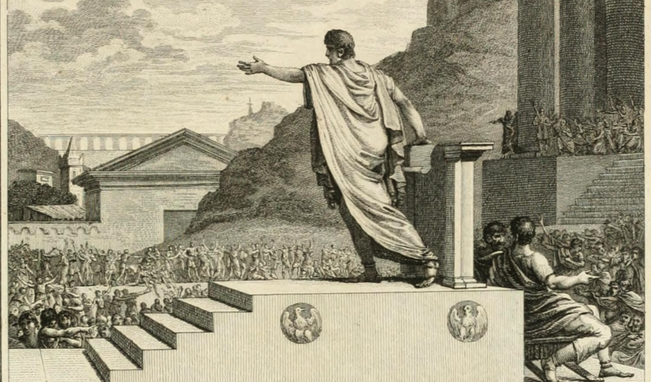 History teaches us that the true guardians of democracy are not state supreme courts or rogue lawmakers, but the people themselves.
In a landscape where the law and politics intertwine, Colorado and Maine’s decision to bar former President Donald Trump from their primary ballots resonates deeply within the heart of American democracy. This isn’t a mere legal maneuver; it’s a high-stakes dance on the tightrope of American electoral politics, balancing constitutional law and political strategy. At the heart of these decisions lies the rarely invoked insurrection clause of the 14th Amendment, a relic from the Civil War that now gains newfound significance. Essentially, it prohibits individuals who have actively worked against the Constitution through insurrection from holding any government position. Ultimately, this issue forces us to ponder how, as a nation, we determine who ascends to the highest echelons of leadership and who does not. It’s a question that doesn’t merely seek an answer; it demands profound introspection and contemplation about the very essence of our self-government. 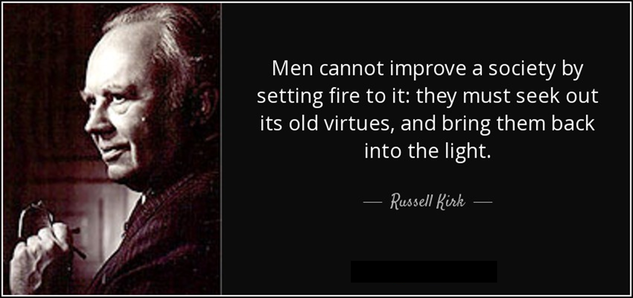 If Kirk were alive today, he would agree with those who are now critical of the neocons for having abandoned their conservatism in favor of an imperialistic and globalist ideology.
While a handful of writers and thinkers before him had adopted the term “conservative” and promoted it in their writings, like Peter Viereck in the 1940s, it was the publication of Russell Kirk’s The Conservative Mind in 1953 that brought the term into public parlance and prominence. Michael Federici gives a brief but insightful introduction to the newly rereleased version of The Politics of Prudence, Kirk’s collection of essays first published in 1993 after the collapse of the Soviet Union and the end of the Cold War. The work attempted to present conservatism anew in an age now free from the ideological struggle of the Cold War. Conservative Character Federici notes that Kirk understood conservatism to be “a disposition of character rather than a collection of reified, abstract political doctrines. It is the rejection of ideology rather than the exercise of it.” This, too, is the understanding of conservatism laid out by the champion of conservatism in the 21st century, my former teacher Sir Roger Scruton. This understanding may help one realize why conservatism fails as an ideology — because it is not an ideology. As Kirk humorously notes early on in one of the early chapters of this book, conservatives who attempt to ideologize conservatism make the first and most egregious error in understanding conservatism. 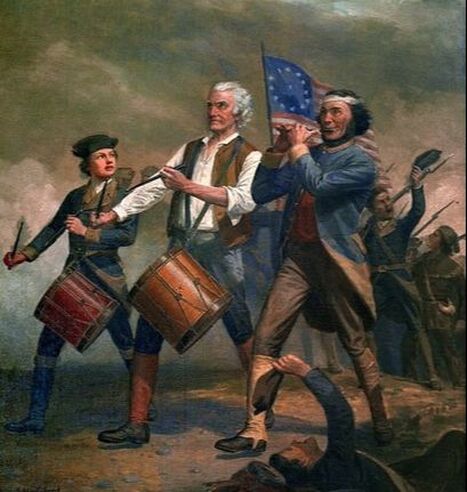 “The left’s attacks against former President Trump and America are unprecedented in US history. Drew Thomas Allen has written a powerful and timely book that gives Americans the fuel they need to confront and defeat the threat of tyranny in our time. Honest and unapologetic, Allen sees opportunity rather than despair as he charges a new generation of Americans to rescue America. America’s Last Stand: Will You Vote to Save or Destroy America in 2024 is the right book at the right time.”
We must not let our Temple of Liberty fall. While our enemy recruits an army of our brothers and sisters to join their jihad to reduce America to rubble by appealing to our worst and wildest passions, we must rise and plant our feet firmly in their midst and preach the truth with cold, calculated reason,” What makes Allen’s book so important is its profound sense and clarity of purpose. Christina Bobb, familiar to many as a frequent guest on Newsmax and an attorney to Donald J. Trump, perhaps best identifies this in her own advanced praise for America’s Last Stand, writing: “The left’s attacks against former President Trump and America are unprecedented in US history. Drew Thomas Allen has written a powerful and timely book that gives Americans the fuel they need to confront and defeat the threat of tyranny in our time. Honest and unapologetic, Allen sees opportunity rather than despair as he charges a new generation of Americans to rescue America. America’s Last Stand is the right book at the right time.” This is, indeed, what distinguishes Allen’s book from so many others. Not only is it the right book at the right time but the book we need at this time. 2024 is the most consequential election of our lifetime and Allen is wildly successful in conveying those stakes and leaving no doubt otherwise in the mind of any reader. Allen’s words are direct and honest. “Our present conflict is unprecedented in our own nation’s history and in our own lifetimes and marks the third major test, which will determine whether America survives or dies,” Allen writes.  The world is burning yet many of our elected representatives can’t seem to find their voice to effect change. Even the Republican Party seems to be sitting it out. This is a problem of party leadership at the national, state, and even the county levels; and that is why I’m entering the race to be your next Weber County Republican Party Chair.
I’m Bill Olson proud father to two beautiful conservative young women, Alyssa & Haley... I am a retired serial entrepreneur and I have gained my Party experience by holding many elected positions over the last 12 years, including:
Let’s be honest with each other...As Republicans, our stated purpose is to nominate and support the election of Republican candidates for public office and promote the principles set forth in our Party Platform. Did you know, all Republican Candidates seeking the nomination of the Utah Republican Party to run as a Republican for any federal, statewide, state legislative, or state school board office are required to sign a Candidate Certification Form declaring: “I Have read the Utah Republican Party Platform, Constitution, and Bylaws. I support the Republican Party Platform...and accept it as the standard by which my performance as a candidate and as an office holder should be evaluated.”  "In 1967 and in 1975, respectively, 75 percent of House members and 81 percent of U.S. senators were veterans. Today less than 20 percent of lawmakers in both houses have had any prior military experience." Veterans Day, which was originally founded around the virtue of the cessation of hostilities in World War I rather than the commemoration of any individual, should be a holiday beyond reproach.
Veterans Day had its origin in 1918 at the end of World War I, a conflict that was at that time so horrendous that it was dubbed “the Great War” or “the war to end all wars,” with the United States playing the decisive role in the Allied Powers’ final victory. It was first known as Armistice Day, celebrated on Nov. 11 because that was the day agreed upon by the Allied nations and Germany to begin a total cessation of hostilities. It went into effect on the 11th hour of the 11th day of the 11th month in 1918, after some 20 million people from both sides had given their lives in the war effort. For many years thereafter, Armistice Day was just recognized on a state level. Twenty years later, when the winds of an even greater war were blowing toward what would be known as World War II — with Germany having annexed Austria and making clear preparations to take over Czechoslovakia — the U.S. Congress passed the act to establish Armistice Day as a legal federal holiday on May 13, 1938. Ironically, it was said at that very time to be “a day to be dedicated to the cause of world peace.”  The constitutionality of RCV turns on whether some voters are afforded “an increased opportunity to affect the outcome of an election” than other voters. Among similarly situated voters, the Equal Protection Clause does not permit some votes to carry a greater weight than others. At the heart of this inquiry is whether RCV’s rounds of tabulation function as one election or multiple elections. I believe RCV functions as multiple elections and in so doing inflicts four primary burdens on voting rights.
1. RCV Operates as Multiple Elections RCV operates as more than one election and in doing so, affords some voters a weightier and unequal opportunity to influence electoral outcomes. Strong evidence that RCV systems produce more than one election exists in the text of RCV statutes, interest groups that support RCV, and state officials who have defended RCV in court. Statutes that enact RCV direct election officials to engage in multiple “rounds” of vote disbursement. Moreover, election scholars confirm that RCV is more than one election. According to leading political science professor and voting systems expert, Dr. Jonathan D. Katz, an election is defined as a given set of voters choosing amongst a given set of candidates. Each time the voters and candidates change, there is a distinct and separate election. In practice, RCV does precisely that. If no candidate receives a majority of votes, the lowest candidates are removed from contention and eliminated from the pool of viable candidates. But not only do the candidates change in subsequent rounds of an RCV election, so do the voters. For example, in one San Francisco RCV election, by the final round of tabulation, twenty-seven percent of voters had their ranked ballots exhausted and were no longer actively participating with the other seventy-three percent of voters. Because both candidates and voters change in every subsequent round, RCV is properly considered not one, but multiple elections. Some may argue that RCV’s practical consequence of producing multiple elections is inconsequential. However, this commonly-deployed argument ignores the more serious threat lurking in the background. Although passed off as “subsequent rounds” of a single election, properly understood, RCV’s multiple elections treat some voters more favorably than others. Voters who rank a non-continuing candidate first, and thus have their second or third choice considered, get to morph their ballots into outcome determinative votes. In contrast, voters who rank a continuing candidate are stuck with a single choice and that single vote. Moreover, while some voters have their votes counted again and again, others have their ballots eliminated in RCV’s subsequent rounds. For an example, consider the election data from a San Francisco RCV election. It is illogical to suggest that the twenty-seven percent of voters who had their ballots exhausted by the last round were afforded an “equal chance” to impact the outcome of the election—they did not even have a vote to exercise in the later elections. Thus, contrary to the Ninth Circuit’s reasoning in Dudum, votes are not afforded the “same mathematical weight” in RCV elections. Rather, RCV operates as multiple, unequal elections where some votes are elevated to outcome-determinative status, some are locked in place, while others are exhausted entirely.  A time for choosing ''Reagan was the great optimist' — he also said we must 'recognize that evil exists in the world'
Ronald Reagan's values, vision and vibrant personal optimism inspired a rebirth of American pride, growth and exceptionalism in the 1980s, after nearly two decades of social and cultural upheaval. "Reagan was deeply concerned about America in the late 70s," Virginia-based historian and author Craig Shirley told Fox News Digital. "America had gone through 17 long, horrible years beginning with the assassination of JFK." The quagmire of Vietnam, the author added, the failed presidency of Lyndon Johnson, the resignation of Richard Nixon, the Iran hostage crisis and the infamous social and economic "malaise" of the Jimmy Carter administration all created the feeling of a nation in decline. Reagan countered the appearance of cultural decay with pro-growth economic policies and an investment in American muscularity abroad. He also invested political capital in the nation’s spiritual rebirth: Patriotism, faith and family, individualism and the belief that the best days for America were still ahead.  “The ceremony of innocence is drowned:
The best lack all conviction, while the worst Are full of passionate intensity.” --W.B. Yeats Osama bin Laden rightly coached his followers that “the people want to follow the ‘strong horse’ and will abandon the weak one.” We are witnessing our nation now being destroyed by the powerful Democrat demons and betrayed by the pitiable weakness and cowardice of our Republican champions. Unless the Republicans, the Patriots, the Conservatives, the lovers of our Constitution, quickly rise up and display backbone, this great American experiment may well perish from the earth. Providence and our brilliant Constitution have given us a legal pathway to saving this nation, but it must be grasped and pursued with courage and righteous power. While the Democrats dishonored the tool of Impeachment against President Trump by using false and illegitimate reasons for their debauched actions, this must not be the excuse for abandoning this worthy instrument for correcting against corruption and stupidity in our highest public offices. The evidence for Biden’s corruption and betrayal of America mounts by the day. We cannot wait for the situation to ripen further.  Click the YouTube link below to watch youtu.be/tIl57cchRqs
Overview shows a straightforward explanation of government systems, basic economics, and timeless moral principles. Because of following them, America became the most unique and prosperous country in history.  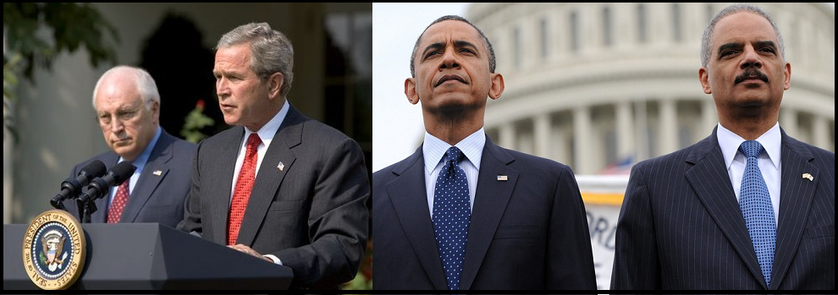 Barack Obama and Eric Holder did not create a weaponized DOJ and FBI; the institutions were already weaponized by the Patriot Act. What Obama and Holder did was take the preexisting system and retool it, so the weapons of government only targeted one side of the political continuum.
This point is where many people understandably get confused. Elevator Speech: (1) The Patriot Act turned the intel surveillance radar from foreign searches for terrorists to domestic searches for terrorists.(2) Obama/Biden then redefined what is a “terrorist” to include their political opposition. In the era shortly after 9/11, the DC national security apparatus, instructed by Vice President Dick Cheney, was constructed to preserve continuity of government and simultaneously view all Americans as potential threats. The Department of Homeland Security (DHS) and the Office of the Director of National Intelligence (ODNI) were created specifically for this purpose. After 9/11/01, the electronic surveillance system, that was originally created to monitor threats from abroad, was retooled to monitor threats inside our country. That is when all of our electronic ‘metadata’ came under federal surveillance. That inflection point, and the process that followed, was exactly what Edward Snowden tried to point out. What Barack Obama and Eric Holder did with that new construct was refine the internal targeting mechanisms, so that only their political opposition became the target of this new national security system.  Once upon a time, there was a coronavirus. Actually, there were several coronaviruses. The CDC lists 229E, NL63, OC43, and HKU1. It goes on to note that they are generally mild respiratory viruses that rarely cause serious illnesses. They are...drum roll, please...common cold viruses.
Over the last twenty years, we've been threatened with panic porn about three other coronaviruses: MERS, SARS, and COVID-19. MERS and SARS appeared to be really bad actors, but instead of the infectious holocaust the Feds predicted, they bombed out. SARS killed 11% of its victims but is known to have infected only 8,649 people. MERS was a bit worse, killing 35% of its victims, but as of 2021, there were only 2,600 total cases. At this point, our attention might wander to Zika and Ebola. Wild-eyed acolytes of the CDC shouted that these new plagues would destroy civilization as we knew it. Instead, they made profits for Anthony Fauci as he rented out his patent on Remdesivir. But it didn't work on Ebola. Then, the story goes, Fauci used our tax money to pay for the Wuhan Institute of Virology to make a bigger, badder coronavirus. This one could not be allowed to be a nothing. It had to be catastrophic so that his medicine would be prescribed for everyone. And a vaccine constructed with his help would also be pleasantly beneficial for his wallet.  We live in an age of unbelief. The foundations of American life are eroding. America is entering an uncharted, revolutionary time. We are no longer the America of our founders or even the America that existed twenty years ago. We are in trouble, and a cataclysm of ominous events may soon overwhelm us. We need a national spiritual revival.
Two seminal revival movements were such game-changing events in American history that historians were compelled to call them Great Awakenings. The First Great Awakening in the mid-1700s created the moral climate for the Declaration of Independence and the founding of a new country, conceived in liberty, that would truly become a light to the nations. The Second Great Awakening in the mid-1800s was even more potent and culminated with Abraham Lincoln and the abolition of slavery. As a result of this movement, the United States has liberated more people economically, politically, and spiritually than any other nation in history. The problems of America today cannot be solved by politicians or our broken culture. We need another Great Awakening on a scale and resolve equal to the first two. There are some hopeful signs this may be happening.  "The rights of every man are diminished when the rights of one man are threatened."
The pages of the Bible are a testament to the downfall of those who plot wicked plans, providing a guidepost for our own battles: "Do the right thing, and risk the consequences." Because, in the end, righteousness prevails. When we were children, bullies would throw sticks and stones and call us names. Today, some of those bullies grew up into "Deep Staters" who brand our truth as conspiracy theories and their lies as truth. As Isaiah warned, "Woe unto them that call evil good, and good evil; that put darkness for light, and light for darkness; that put bitter for sweet, and sweet for bitter!" (Isaiah 5:20). Intimidation: Goliath, the Philistine giant, was a colossal embodiment of intimidation. Against him, the Israelites felt powerless. But with faith as his guide, David overcame. Today, we grapple with the "Giant of the Deep State," an insidious, unseen force that operates behind the curtains, manipulating political structures. These unelected puppet masters, who wield undue influence, can seem overwhelming, yet we are reminded: "The Lord is my light and my salvation; whom shall I fear? The Lord is the stronghold of my life; of whom shall I be afraid?" (Psalm 27:1). With God, even the mightiest, most covert enemies like Satan and his Deep State accomplices can be vanquished. Arrogance: Haman's story is emblematic of the consequences of unchecked arrogance. His malicious designs against the Jews were foiled by Esther and Mordecai, leading to his own destruction. Proverbs 16:18 observes, "Pride goes before destruction, and a haughty spirit before a fall." Seduction and brazenness: Jezebel and her prophets of Baal epitomized seduction and brazenness, drawing Israel away from God. But God's enduring plan saw through their machinations. As it was in 1 Kings 18:39, "The Lord, He is God! The Lord, He is God!" In the time of Nehemiah, as the Israelites endeavored to rebuild their city's walls, they faced adversaries in Sanballat and Tobiah. Yet Nehemiah remained resolute. The people built the wall with one hand and defended with the other, illustrating that perseverance and faith can overcome any opposition. Today's world seems rife with insurmountable challenges. But when we embrace our "spiritual" sight over our "natural" eyes, we perceive the greater cosmic battle. As the Bible reassures, "I can do all things through Christ who strengthens me" (Philippians 4:13). Echoing biblical teachings, John F. Kennedy once remarked, "The rights of every man are diminished when the rights of one man are threatened." We must stand unwaveringly against any evil, no matter its form. Gerald McGlothlin |
AuthorBill Olson Archives
April 2024
Categories
All
|
We Would Love to Have You Back Again Soon! |
|



 RSS Feed