
WEBER COUNTY CONSERVATIVES
  • Home
  • About Us
  • Caucus 2026
  • Precinct Chair Duties
  • Billy O's Blog
  • REPUBLICAN PARTY AUTONOMY
  • ​Honesty in Membership
  • Patriot Training
  • SCC Review
  • CCC Training
  • SB 54
  • WEBER PRECINCTS TOWNHALL
  • THE FREEDOM CAUCUS
  • ERIC and the vote
  • Paper Ballots Now
  • The Brandenburg Files
  • HOW TO SURVIVE AN EMP ATTACK
  • Reading Room
  • Training Videos
    • REPUBLICAN PARTY PLATFORM Video
    • County Delegate Training Video
  • Contact Us

Billy O's Blog

Picture
Click NEXT at bottom of each page to see more blog posts

CLOSING THE DEEP STATE GAP: A PROPOSED LAW TO RESTORE CONSTITUTIONAL ORDER

1/31/2026

0 Comments

 
Picture
Is the problem the law itself?

The proposed Executive Integrity and Oath Protection Act, outlined in Tadas Klimas's January 9, 2026, American Thinker article "Closing the Deep State Gap: A Proposed Law to Restore Constitutional Order," offers a bold, necessary step toward dismantling the unelected bureaucracy that has usurped power from the people's elected president. As conservatives in Weber County and across Utah know all too well, the real threat to self-government isn't always overt tyranny...it's the slow, insidious sabotage by entrenched officials who swear oaths to the Constitution but act to undermine the executive chosen by voters.

Klimas rightly identifies the core issue: current federal law lacks a specific criminal offense for deliberate abuse of office that targets the lawful functioning of the presidency. Sedition statutes require force or overt rebellion; existing crimes like obstruction or perjury don't fully capture the "soft" coup tactics we've witnessed...from the Russia hoax leaks and weaponized intelligence to novel legal theories deployed in lawfare against political opponents. These acts erode the unitary executive under Article II without fitting neatly into traditional criminal categories, allowing perpetrators to "skate" while the American people suffer the consequences.

The proposed bill closes this gap with precision and safeguards. It criminalizes:
​
  • Using official authority to promote knowingly false or misleading information (e.g., intelligence community statements or leaks designed to deceive the public and hamstring a president).

  • Sham procedural compliance that evades substantive safeguards while intending to obstruct executive action.

  • Prosecutorial abuse via stretched, untested legal theories against sitting or former high-ranking officials when the motive is interference rather than justice.

Penalties are serious...up to 10 or 20 years imprisonment, forfeiture of office, permanent disqualification from public service, and restitution...yet the bill includes robust defenses: good-faith reliance on reasonable legal advice, protections for whistleblowing, congressional oversight, and judicial proceedings. Prosecutions require Attorney General approval plus a special federal judicial panel's probable cause finding, minimizing the risk of weaponization against legitimate actors.

This isn't about revenge; it's about restoration. The Constitution vests executive power in one elected president, not a permanent class of "experts" insulated by civil service rules and "independent" agencies. As Klimas notes, the expansion of these protections over decades has created a de facto oligarchy that thrives on compliant or weak presidents. True accountability demands that subordinates owe faithful execution...not personal loyalty to agendas, but to the constitutional chain of command.

In an era where unelected bureaucrats have launched baseless investigations, leaked classified information to sway elections, and pursued endless probes against political foes, this law would deter future sabotage. It reaffirms that government employees serve at the pleasure of the people through their president, not as an autonomous fourth branch.

Congress should introduce and pass the Executive Integrity and Oath Protection Act without delay. President Trump's return provides the mandate and momentum to enact such reforms. By criminalizing oath-breaking sabotage with clear intent requirements and judicial checks, we can restore the Founders' vision: a government accountable to the electorate, not insulated from it.

Utah's conservative grassroots—through caucuses, conventions, and activism—can amplify this call. Contact your representatives, demand hearings, and make clear that closing the Deep State gap is essential to making America great again. The time for half-measures is over; constitutional order demands action now.

www.americanthinker.com/articles/2026/01/closing_the_deep_state_gap_a_proposed_law_to_restore_constitutional_order.html | January 9, 2026
0 Comments

THROUGH THE LOOKING GLASS

1/1/2026

0 Comments

 
Picture

My Journey from California Liberalism to Utah Conservatism: Inspired by Reagan’s Timeless Vision

A Childhood in the Shadow of Turmoil

I moved to Southern California shortly after I was born in 1953, at the tail end of the postwar boom when the Golden State still felt like the land of endless opportunity. My high school years stretched from 1967 to 1971, a time when the world seemed to unravel before our eyes while rock & roll excelled. The Vietnam War dominated everything: protests on campus, body counts in the morning paper and again on the nightly news, friends' older brothers shipping out. In 1971, my draft lottery number came up on TV...14, yea...Fourteen. I remember staring at that TV screen, heart pounding, knowing it meant almost certain service in a war that was deeply mismanaged. Suddenly, the draft ended and the all-volunteer military was established—just in time for me to escape the call, but the fear, the uncertainty, and the deep questions about government integrity never left me.

Bartending My Way to a College Degree

After high school graduation, I moved down to Orange County—still affordable then, still full of promise—and put myself through college by bartending nights and weekends in Balboa. Shaking cocktails at the Studio Café paid the bills while I studied Political Science with a focus on International Relations at Loyola Marymount University in Los Angeles. I minored in Philosophy and took every Constitutional Law class I could. My specialty became the politics of oil, which felt painfully relevant as I drove back and forth to campus during the shortages of the mid-1970s, praying the station on the corner still had gas on my even or odd day.

My First Vote and the Pull of Progressive Promises

In 1976, during America's Bicentennial, I was president of the Political Science Association. I organized voter registration drives on campus—bonfires, cold beer, red-white-and-blue banners—and I enthusiastically registered Democrats. That fall, at age 23, I cast my first presidential vote for Jimmy Carter. I believed his promises of compassion, healing after Watergate, and a new kind of honesty in government. Like so many of us raised in that era, I leaned left, drawn to the emotional appeals for equality, social justice, and caring for the vulnerable...and what interested the girls.

The Awakening: Malaise and the Voice of Reagan

But life, observation, and hard experience have a way of reshaping convictions.

The late 1970s hit like a slow-motion disaster: double-digit inflation eating paychecks, gas lines snaking around blocks, the Iran hostage crisis dragging on for 444 humiliating days. By 1980, the national malaise Carter himself named felt suffocating. That's when Ronald Reagan's voice cut through the fog for me. Reagan was the great optimist who never flinched from declaring we must "recognize that evil exists in the world." After two decades of upheaval—from JFK's assassination through Vietnam, Nixon's resignation, and Carter's weaknesses—Reagan offered a rebirth of American pride, growth, and exceptionalism. His message of pro-growth economics, strong defense, and spiritual renewal rooted in faith, family, and patriotism spoke directly to the disillusioned young man I'd become. I voted for him in 1980 and again in 1984, watching as he restored confidence at home while developing a tremendous business environment and staring down the Soviet "evil empire" abroad.

Reagan’s Principles Become My Compass

Reagan governed California while I was coming of age there, and his principles became my compass. He trusted the everyday American—the bartender pouring drinks after a long shift, the factory worker, the small-business owner—believing greatness flows from enlightened individuals, not distant bureaucrats. He warned that freedom is never more than one generation away from extinction, a line that still chills me. And he reminded us that the American experiment—a constitutional republic united by universal ideals, not blood or soil—is both miraculous and fragile.

Watching California Drift Away

Yet over the decades, I watched California drift far from those principles. Policies sold on compassion—affirmative action quotas, unchecked immigration after the 1986 amnesty, ever-expanding welfare, crippling regulations, relentless gun control—delivered resentment, strained resources, declining schools, rising crime, and a hollowed-out middle class. NAFTA shuttered factories across Southern California. Green mandates brought rolling blackouts and soaring energy costs, echoing the shortages I'd lived through as a student. Each failure followed the same heartbreaking pattern: heartfelt intentions, massive government intervention, unintended consequences, blame deflected elsewhere.

Lessons from a Lifetime in Business

These weren't abstract debates—they touched every part of my life. After college, I built a 45-year entrepreneurial career, co-founding and leading companies in professional golf (a women's developmental tour preparing players for the LPGA), high-tech database development, direct marketing, waste-heat recovery for power generation, and molecular diagnostics. In business, I learned brutally and repeatedly that results matter more than intentions. Accountability in a fiduciary environment, merit, and limited interference drive success; government overreach does the opposite.

Post-9/11: Channeling Patriotism into Innovation

That lesson crystallized after 9/11. The attacks shook me to my core. Too old for military service, I channeled my anger and patriotism into energy independence. Researching America's staggering waste—over 60% of industrial fuel lost as heat—we licensed a breakthrough patent and founded ElectraTherm. We pioneered low-temperature waste-heat-to-power technology, turning factory exhaust into clean electricity. Awards followed, and in 2011 even President Obama visited our facility, praising the innovation. We were acquired by a global leader, and the technology now reduces CO2 emissions worldwide. This was the America I loved—the one of ingenuity and self-reliance—and I became determined to defend it for my children and grandchildren.

Turning to the Intellectual Foundations of Conservatism

The widening gap between progressive promises and real-world outcomes drove me deeper into study: Milton Friedman's clear-eyed defense of free markets, Thomas Sowell's empirical takedowns of leftist myths, and the Federalist Papers' timeless case for limited, balanced government. These are cornerstones, and building on them has deepened my understanding of why good intentions so often go awry, and why conservatism (rooted in human nature, incentives, and constitutional wisdom) offers better answers.

A New Chapter in Utah

Eventually, the California I'd grown up in—high taxes, declining schools, rising crime, eroding freedom—became unbearable. In 2002, my wife and I moved to Utah to start a family, drawn by stronger communities, lower taxes, and a culture that still valued self-reliance and principle. Here, my hard-earned conservatism flourished.

Diving into Grassroots Republican Politics

In Weber County, I threw myself into the Republican Party: precinct chair and vice chair, legislative district chair and vice chair, county and state delegate, service on central and executive committees. In 2017, alarmed by low participation and institutional drift, I founded Weber County Conservatives to train volunteers and delegates in civics and party governance.

Discovering Utah’s Unique Caucus System

What captured my heart in Utah was the caucus-convention system—neighbors gathering in local meetings to deliberate, elect delegates, and hold candidates accountable. It's the closest thing we have to true self-government, the purest expression of republicanism. As precinct vice chair, I hung 100 door hangers, ran training sessions, and begged leadership for better outreach tools. Yet turnout remained dismal—only 8% in my precinct—because the party clung to outdated methods while big-money interests pushed to dismantle the system entirely.

The Fight Against SB54 and Party Drift

That fight became personal. SB54 in 2014 allowed signature-gathering to bypass caucuses, letting fame or fortune override grassroots voices. Opportunists—sometimes not even genuine Republicans—began hijacking the party label. Leadership often looked the other way, enforcing neither platform loyalty nor bylaws. I watched in disbelief as some endorsed candidates opposing the party's clear supermajority choice. Principles became negotiable; power became the prize.

Proposing Reforms to Restore Integrity

This betrayal spurred action. Drawing on First Amendment precedents and the party's own authority, I have offered proposals to restore integrity: require one-year Republican registration, public loyalty certifications, and rules declaring that signature-gathering forfeits party membership. Under these reforms, only convention-supported candidates would appear on the ballot as Republicans—functionally neutralizing SB54's damage without needing legislative repeal.

The Wisdom of Rural America

Rural Utah embodies the America the Founders envisioned: self-sufficient families, land ownership, independence from centralized control. Jefferson, Washington, Adams, Madison—all farmers—would be appalled at today's urban dependence and cultural decay. Rural communities remain the strongest conservative stronghold, guardians of originalist constitutionalism, patriotism, and common sense. Their wisdom is our best hope for restoration.

A Partnership with God

God's blessing on America has always been a partnership. We must remember the price paid for freedom—from Normandy's beaches to today's threats. We must wait on the Lord for strength. And we must be the faith—loving even those with whom we fiercely disagree, proclaiming liberty throughout the land.

Echoes of Reagan in a New Era

As we stand on January 1, 2026—the threshold of America's 250th anniversary—Donald Trump's triumphant return echoes Reagan's transformative victories. Both rose amid despair, rejected moral equivalency, recognized evil, and rebuilt strength through bold economics, energy independence, and unapologetic power. Reagan's shining city on a hill lives anew in Trump's America First movement, restoring dignity to individuals, sanctity to borders, and trust in the goodness of the American people.
The solution remains what Reagan said: a matter of the human heart.

My journey—from a 1953-born California kid staring at draft number 14 on the television screen, bartending late nights in Balboa to pay for college, casting my first vote for Jimmy Carter in 1976 with hopeful idealism, to a Utah conservative who has spent years training the next generation to defend self-government and constitutional principle—has been forged in the crucible of hard-won experience, unflinching reason, deepening faith, and the timeless vision Ronald Reagan gave us.

Those principles pulled America from the depths of malaise once before, restoring pride, prosperity, and strength. Today, as we stand at the threshold of our nation's 250th year, they burn brighter than ever in the America First renewal we are witnessing. With God's grace guiding our hearts and our unwavering resolve steeling our hands, we will lift her once again—not just to endure, but to shine as that city on a hill for generations yet unborn.
God bless America.

By BillyO
0 Comments

A REPUBLICAN PARTY CHRISTMAS CARROLL - The Ghosts of Party Past, Present, and Yet to Come.

12/21/2025

0 Comments

 
Picture

Before I begin, I want to explain why I’m writing this...and why I’m doing it this way.

The subject we’re discussing tonight is serious: conflict of interest, trust, and the integrity of our Party’s internal governance. Normally, we approach topics like this with policy briefs, motions, and parliamentary language. All of that matters...but sometimes, rules alone don’t reach the heart of the issue.

Charles Dickens used storytelling not to entertain for entertainment’s sake, but to tell hard truths in a way people could hear without immediately becoming defensive. A Christmas Carol wasn’t really about Christmas. It was about responsibility, stewardship, and the consequences of ignoring moral boundaries until it’s too late.

What I’m about to share is not an accusation against any individual. It questions no one’s integrity or motives. Instead, it asks us to look honestly at structure...at whether the way we are organized today protects grassroots Republicans as well as it should.

Stories have a way of slowing us down. They help us see patterns rather than personalities, consequences rather than conflicts. That’s why I’m using this form tonight.

As you read, I’d ask you not to look for villains or heroes. Listen for yourselves. Listen for where trust is gained...or quietly lost...and for what kind of Party we want to be a year from now, five years from now, and beyond.

With that, I’d like to share my story...

​"
A Dickensian Parable for the Utah Republican Party"

Marley was dead: to begin with. Dead as a caucus turnout in a blizzard. Old Jacob Marley, legendary lobbyist and part-time SCC gadfly, had finally cashed in his last campaign check. His chains? Forged from decades of “perfectly legal” revolving-door deals, expense-account steak dinners, and endless fights over SB54.

But his old partner, Ebenezer Carroll...current Chair of the Utah Republican Party’s State Central Committee...was very much alive, and twice as grumpy. Carroll was a squeezing, wrenching, grasping, clutching, covetous old insider. His smile was as rare as a moderate at convention...or a peaceful debate over signature gathering.

When a delegation of earnest precinct chairs suggested banning elected officials, staffers, and lobbyists from SCC roles (just like the real 2025 convention proposal that got ruled unconstitutional), Carroll snarled: “Conflict of interest? Bah! Humbug! Let the legislators, their staffers, and every lobbyist with a Capitol parking pass run the whole show! It’s called synergy, you rubes! Grassroots are great for knocking doors, but governance? Leave it to the pros...who’ve been battling SB54 since 2014!”

Christmas Eve found Carroll alone in Party HQ, muttering over delegate spreadsheets and a lukewarm cup of Diet Coke (caffeine-free, of course...standards must be maintained). Suddenly the door knocker morphed into Marley’s ghostly face, dragging chains that clanked like loose ethics filings.

“Carrolllllll!” moaned Marley. “These are the chains I forged in life...lobbying by day, steering the SCC by night, and pretending nobody would notice the blurred lines! Three Spirits are coming to audit your soul. Good luck!”

Carroll rolled his eyes so hard he nearly pulled a muscle.

The Ghost of Party Past

The first Spirit showed up looking like a pioneer cosplayer who’d raided the This Is the Place gift shop. Torch in hand, bonnet slightly askew.

“Touch my hem, Scrooge...er, Carroll.”

They zoomed through visions of the UTGOP’s glory days: Back in the late 1800s, after statehood in 1896, Utah flipped Republican fast...despite early Democratic leanings tied to church leaders...thanks to federal anti-polygamy pressure. Neighborhood meetings in folding chairs, zero lobbyists in sight, legislators politely waiting their turn. The unique caucus-convention system took root, letting grassroots delegates pick nominees without big money or signatures. No "synergy" poisoning the well...just pure independence, holding elected officials accountable from the Goldwater-loving 1960s through Reagan's massive wins in the '80s.

“Spirit,” grumbled Carroll, “those were the days before Count My Vote threatened to blow it all up with direct primaries.”

The Spirit showed young Carroll, a wide-eyed delegate, being ignored while a senator’s chief of staff hijacked the microphone to “share some thoughts from the boss.” Little Carroll looked crushed.

“Feels bad, man,” said the Spirit. “Back then, the Party belonged to ordinary Republicans, not insiders fighting over ballot access.”

The Ghost of Party Present

The second Spirit was a jolly giant in a red “Utah GOP” sweater two sizes too small, surrounded by a potluck throne of iconic Utah holiday fare.

But under the robe lurked two hideous children: Suspicion and Cynicism.

“Look upon the current Party!” boomed the Spirit.

They spied on a Grassroots family Christmas: Bob Grassroots, a loyal precinct chair who’d knocked doors since Quayle was VP, trying to explain politics to his kids amid plates of funeral potatoes and wobbly green Jell-O.

“Daddy, why does Senator Bigshot get to chair the platform committee and vote on his own bills? And why are we still fighting SB54 after 11 years of lawsuits and lost court battles?”

“Hush, Tiny Delegate,” said Bob, sighing. “That’s just how synergy works...ever since Count My Vote forced the 2014 compromise to save the caucus system from total extinction. Pass the ham...and pray for clearer boundaries.”

Later, at an SCC meeting (echoing real 2025 debates over eligibility bylaws and SB54 repeal efforts), delegates whispered:
  • “That lobbyist just killed the term-limits plank...guess who his biggest client is?”
  • “The Chair’s chief of staff is parliamentarian? Convenient!”
  • “I moved here for low drama, not endless insider power grabs or Game of Thrones... Beehive Edition.”

Carroll squirmed. “They’re overreacting! Nobody’s actually corrupt...just effective, like in all those failed challenges to SB54!”

The Spirit pointed to the kids under the robe. “Meet Suspicion and Cynicism. Feed them more ‘appearance of conflict’...like legislators and lobbyists in dual roles amid grassroots vs. establishment wars...and watch them grow into full-blown Schism, Exodus, and maybe another splinter faction.”

The Ghost of Party Yet to Come

The third Spirit was a silent, hooded figure who communicated exclusively through ominous pointing...like a grim Uber driver giving one star after a chaotic caucus ride-share.

Visions: Future conventions with half the delegates (grassroots fleeing amid endless insider battles and SB54 repeal failures). Headlines screaming “UTGOP Captured by Insiders...Grassroots Flee to Libertarians or Apathy.” Ongoing redistricting dramas dragging into 2026 and beyond. A lonely Facebook group called “Remember When the Party Was Ours...Pre-SB54?” with 47,000 members.

​Finally, a tombstone under snowy Capitol lights:

“Here Lies the Independence of the Utah Republican Party...Cause of Death: Chronic Synergy Poisoning and Unresolved Caucus Wars Survived by Three Lobbyists, Out-of-State Consultants, and a Partridge in a Pear Tree”

Carroll dropped to his knees. “Noooo! I’ll change! I’ll adopt the stupid policy...or at least support real debate on conflicts without ruling it unconstitutional! Anything but irrelevance!”

The Final Stave: Redemption (With Receipts and Resolutions)

Christmas morning, Carroll burst into the emergency SCC Zoom call like a man who’d seen his own political obituary.

“Merry Christmas, you magnificent bastards! We’re debating...and maybe adopting...a real Conflict-of-Interest Policy TODAY, alongside strengthening the caucus system we’ve defended since 2014!”

He read it aloud with gusto:

“No elected officials, no staffers, no paid lobbyists in Party governance...ever. You can still vote, delegate, donate until it hurts, and lobby the Legislature, but the steering wheel stays with the grassroots. No more ‘synergy.’ No more ‘but he’s really effective!’ Just clean lines, zero excuses, restored trust...and maybe finally moving past the SB54 wars that nearly bankrupted us.”

A legislator on the call whined, “But who will explain the nuances of my bills to the SCC?”

Carroll grinned wickedly. “We’ll manage. Somehow. The grassroots built this Party from pioneer days...they can steer it through modern battles too.”

The vote: Overwhelming yes (in this vision, anyway). Even the lobbyists clapped...mostly out of relief that the drama was over, and perhaps hoping for clearer rules at the next convention.

Tiny Delegate raised a glass of Martinelli’s: “God bless us, every one...and keep the insiders in the cheap seats where they belong, with full participation but no double-dipping on power!"

And so, as the snow settles softly over the illuminated dome of the Utah State Capitol and the echoes of caucus bells fade into the winter night, Ebenezer Carroll...once a covetous guardian of "synergy"...stands transformed. In embracing the Conflict-of-Interest Policy, he honors the Party's pioneer roots: the fierce independence forged in statehood's early fires, the grassroots fire that powered Goldwater, Reagan, and every hard-fought convention since; the sacred caucus-convention system defended through a decade of SB54 battles, lawsuits, and near-catastrophe.

No longer shall elected officials, their staffers, or paid lobbyists blur the lines between government power and Party governance, for the UTGOP exists not to serve insiders or special interests, but to amplify the voice of ordinary Republicans...the door-knockers, the precinct faithful, the delegates who believe power flows upward, not down from the Capitol steps.

This reform, principled and long overdue, banishes the ghosts of suspicion, cynicism, and undue influence, restoring trust, transparency, and true grassroots strength. In the words of Tiny Delegate, lifted high with Martinelli’s sparkling cider: “God bless Us, Every One...and may the Utah Republican Party forever remain independent, accountable, and firmly in the hands of its members.” Merry Christmas, and onward to a brighter, cleaner future.
​
Merry Christmas, Utah GOP. May our boundaries be clear, our conflicts nonexistent, and our political organizations thrive with integrity in the new year.

by BillyO
0 Comments

PARLIAMENTARY INTEGRITY AND THE COLLAPSE OF DILBERATIVE GOVERANCE IN THE UTGOP

12/18/2025

1 Comment

 
Picture


A Firsthand Record of Parliamentary Failure in the Utah Republican Party

What follows is not theory, speculation, or secondhand reporting. It is my direct experience as an elected participant in the governance of the Utah Republican Party’s State Central Committee (SCC) and as a duly registered delegate to the Utah Republican State Convention. I was present for the meetings described. I witnessed the procedural failures in real time. And when internal safeguards failed, I pursued formal remedies through the proper institutional channels.

I am not a casual observer of parliamentary governance. I understand the role of deliberative assemblies, the purpose of governing documents, and the protections parliamentary law is designed to afford members. When those protections are ignored...whether through incompetence, indifference, or intent...the result is not merely disorder. It is the erosion of member rights and the corruption of collective decision-making.

This document records a sustained breakdown in parliamentary integrity within the Utah Republican Party, including formal findings of misconduct by a Professional Registered Parliamentarian and a broader, documented pattern of leadership failures that harmed the organization, disenfranchised members, and undermined trust in Party governance.

The State Central Committee as a Deliberative Assembly

The State Central Committee (SCC), as the governing and policy-making body of the Utah Republican Party (UTGOP), is a deliberative assembly. Its authority flows from its members, who are elected by every county in Utah. As with all deliberative bodies, its legitimacy rests on one foundational principle: questions must be fully and freely debated before decisions are made.

Parliamentary law exists to protect that process. It ensures that:
  • the majority may govern,
  • the minority retains enforceable rights,
  • and no presiding officer may substitute personal will for the will of the body.

As parliamentary authorities consistently state, “the leader’s role is to facilitate the group in making decisions. The focus is on the will of the members, not the will of the presiding officer.”

Appointment of the Parliamentarian

After being elected Chairman of the Utah Republican Party in 2017, Rob Anderson claims he contacted the Republican National Committee (RNC) seeking a recommendation for a parliamentarian. The RNC recommended Carrie Dickson, a Professional Registered Parliamentarian, who thereafter served as the official parliamentarian for UTGOP SCC meetings. Ms. Dickson has provided professional parliamentary services to the UTGOP for several years.

At the time, Professional Registered Parliamentarians were certified by the National Association of Parliamentarians (NAP), the national credentialing organization for parliamentary professionals. According to NAP, its members “have reached the highest level of proficiency in the practice of parliamentary procedure.”

Ethics Complaint and NAP Findings

On October 16, 2017, I filed a 43-count ethics complaint with the National Association of Parliamentarians against Ms. Dickson, arising from conduct at the September 9, 2017 SCC meeting. Due to the scope of the complaint and intervening holidays, the NAP President granted an additional  30-day extension for completion of the investigation.

According to the NAP, each allegation was reviewed individually under the Ethical Standards in Relation to Clients, using:
  • the complaint narrative (my complaint)
  • the respondent’s written response (she saw mine and I was not allowed to see hers)
  • the circulated agenda,
  • the parliamentarian’s prepared script (I was never allowed to see it...if it existed)
  • the UTGOP Constitution and Bylaws (know them well...)
  • and governing parliamentary authority 

A parliamentarian’s role has two core responsibilities:
  1. Ensuring the meeting proceeds according to the agenda and governing rules, and
  2. Ensuring motions are handled fairly, consistently, and in accordance with members’ rights.

A parliamentarian may advise, interpret, or cite rules...but never rules. Final authority rests with the Chair. When parliamentary failures occur, responsibility may be shared between the parliamentarian who advised and the presiding officer who acted...or ignored that advice.

Upon conclusion of its investigation, the NAP Ethics Committee formally reprimanded Ms. Dickson for:

  • "Failing to call to the attention of the presiding officer violations of the UTGOP Bylaws"
  • "Preparing a script that conflicted with UTGOP Bylaws"
  • "Violating basic tenets of parliamentary procedure"
  • "Deviating from governing rules in a manner harmful to the organization"
  • "Violating the rights of SCC members"

These findings were not opinions. They were determinations by the national credentialing authority governing professional parliamentarians.

A Pattern of Governance Failure

When a parliamentarian prepares a script for a deliberative assembly and violations occur, one of two things has happened: either the advice was incorrect and followed, or correct advice was ignored. Neither outcome serves the organization.

While Chairman Anderson was not properly served by Ms. Dickson in these specific instances, he has, on numerous other occasions, ignored parliamentary advice entirely, resulting in SCC meetings devolving into disorder, confusion, and procedural abuse.

What follows is not an exhaustive list, but a representative record of governance failures under Chairman Anderson:
  • Ignoring valid, seconded motions from SCC members
  • Disregarding appeals to the ruling of the Chair
  • Making motions without authority
  • Violating bylaws through improper agendas
  • Circumventing SCC authority on the SB54 lawsuit
  • Operating the Party without an approved budget
  • Usurping the constitutional duties of the Party Secretary
  • Failing to provide financial data to audit committees
  • Improperly reconvening meetings during recess to advance controversial motions
  • Allowing mockery of SCC members in open meetings
  • Registering the UTGOP as a Qualified Political Party without SCC consent

Taken cumulatively, this conduct reflects not isolated error, but systemic disregard for deliberative governance.

___________________________________________

The Convention: Where the Pattern Became Public

I did not come to the 2024 State Republican Convention lightly, and I did not come unprepared.

I spent nearly an hour and a half standing in line just to register as a delegate. When I entered the convention hall, it was already full. Nearly half the delegates raised their hands when asked if this was their first convention. That mattered...because a deliberative assembly is only as strong as its members’ understanding of their rights.

After the prayer, the Pledge of Allegiance, and approval of the rules and agenda, we began. I was standing at the microphone, waiting my turn, prepared to participate as a delegate in a deliberative assembly representing all 29 counties of Utah.

That is what a state convention is supposed to be: full and free discussion, exhaustive debate, and decisions made by the body...not imposed by leadership.

Paper Ballots, SCC Authority, and Conflict of Interest

Long before the convention, many delegates were deeply concerned about the direction of the Party and its leadership. Since SB54, the caucus-convention system has been effectively neutered, allowing candidates to bypass delegate scrutiny and Party endorsement.

The SCC...the Party’s governing body...had already directed the use of paper ballots.

Yet it became clear that Party leadership had no intention of executing that directive. Instead, leadership moved to impose electronic voting, despite:
  • SCC policy,
  • a petition signed by over 400 delegates,
  • and explicit Republican National Committee guidance calling for hand-marked, voter-verified paper ballots.

Adding to the concern were apparent commercial conflicts of interest, with individuals promoting electronic voting services occupying leadership positions on convention committees...committees that are, by Constitution, recommending bodies only.

The Point of Order

As the Elections Committee Chair began instructing delegates on how to use the electronic voting system, I raised a Point of Order.

A Point of Order is a privileged parliamentary motion. Once recognized, the member has the floor and may not be interrupted. The Chair must rule. That ruling may be appealed. Ultimately, the body decides. But I had the floor!

My Point of Order asked a simple question, met with loud applause:

By what authority does a recommending committee overrule the State Central Committee...the governing body of this Party...and impose electronic voting on the delegates?

The Chair ignored the Point of Order. He said he would “get to it later” and allowed the committee to proceed....The parliamentarian...present to protect the rights of the assembly...and the delegates...was silent.

When I persisted and asked the Chair for a ruling denying my Point of Order, so I could challenge it and allow the delegates to decide. Apparently, he was not bound by the SCC’s decision...when I persisted WITH THE FLOOR!... my microphone was shut off.

At that moment, my rights as a delegate were stripped away in full view of the assembly. I had the floor. I had the right to appeal. I had the right to force a vote of the body. All of it was denied. THE CHAIR WAS OUT OF ORDER!

I stood there without sound, waving the microphone, ignored by both the Chair and the parliamentarian. Realizing the body did not understand that its silence meant surrender, I dropped the microphone and left the convention... embarrassed for the delegates and outraged at leadership for exploiting their ignorance.

One Record, One Pattern

This experience did not stand alone. It was the public culmination of a pattern I had already documented through years of firsthand observation, formal parliamentary challenges, and ultimately a successful ethics complaint to the National Association of Parliamentarians.

The same failures identified by NAP...silence in the face of bylaw violations, scripts in conflict with governing rules, deviation from procedure harmful to the organization...were on full display at the convention.

This is not a collection of grievances. It is a single, unified record:
  • from SCC meetings to the convention floor,
  • from ignored motions to silenced microphones,
  • from internal warnings to external reprimands.

When rules are ignored consistently, outcomes are no longer the product of deliberation...but of power exercised without consent.

Conclusion: Why This Matters

Deliberative bodies only function when rules are followed and leaders respect the will of the members. Parliamentary procedure is not a nuisance...it is the safeguard against tyranny, whether in government or within a political party.

The failures documented here altered outcomes, excluded duly elected members, and eroded trust in the Utah Republican Party’s governance. When members surrender their rights...knowingly or unknowingly—those rights do not disappear. They are taken.
​
The only remaining question is whether the members of the Utah Republican Party will reclaim the authority that already belongs to them.

​by BillyO
1 Comment

WHY UTAH REPUBLICANS MUST DECIDE WHO THE PARTY EXISTS TO SERVE

12/18/2025

0 Comments

 
Picture

Utah Republicans win elections easily...and lose their voters quietly. When a party forgets who it exists to represent, power becomes management, not representation.

Utah is one of the most reliably Republican states in the nation. Republicans hold supermajorities in the Legislature, control statewide offices, and dominate local government. And yet, many Utah Republicans feel politically homeless.

That contradiction should trouble us.

The problem is not electoral. It is philosophical. Over time, the Utah Republican Party has quietly adopted a definition of political identity so thin that it no longer anchors governance to a people, a place, or a set of lived obligations. Republicanism has been reduced to abstract principles... markets, process, civility, efficiency...divorced from the question every real political party must answer: Who are we here to represent?

If anyone can be a Republican, then no one really is.

This is not an argument for exclusion by race or ancestry. It is an argument for coherence. A political party, like a nation, cannot survive as a purely propositional construct. Ideas matter...but ideas require a constituency to whom leaders are accountable. Without that grounding, power naturally flows upward to institutions, markets, and elites rather than downward to voters.

Utah governance increasingly reflects this error.

On immigration and workforce policy, Republican leaders often speak as if Utah were merely an economic zone. Labor shortages are framed as problems to be solved through population inflows rather than through higher wages, stronger families, or workforce development. The impact on housing costs, schools, cultural cohesion, and working-class Utahns is treated as incidental. Market throughput takes precedence over community stability.

On housing and land use, Republicans invoke supply-side economics while enabling centralized planning, density mandates, and development incentives that favor national firms over local builders and families. Growth is measured in units and projections, not in whether Utahns can afford to live near their parents or raise children in the communities that shaped them.

On education, process is defended more vigorously than parents. Bureaucratic systems are protected in the name of neutrality, while questions of moral formation and local control are dismissed as divisive or unsophisticated. Subsidiarity is praised in theory and ignored in practice.

On corporate incentives, Utah Republicans routinely socialize risk and privatize reward...offering tax abatements, infrastructure, and regulatory favors to multinational firms whose connection to Utah extends no further than a balance sheet. There is little expectation of long-term rootedness, cultural integration, or loyalty to the people whose taxes underwrite the deal.

These are not isolated policy disagreements. They are symptoms of a deeper problem: a party that no longer clearly understands who it exists to serve.

Under today’s prevailing model, Republican identity is infinitely elastic. A global corporation aligned with free-market rhetoric, a transient professional class, or a consultant fluent in conservative buzzwords can claim the label just as easily as a Utah family whose faith, labor, and future are bound to this state. Loyalty flows upward to systems and abstractions, not downward to voters and communities.

That is why Republican control no longer guarantees Republican outcomes.

A functioning party must be able to draw boundaries...not of blood, but of obligation. It must be willing to say that its first duty is to the people who built the state, sustain its institutions, and will live with the consequences of today’s decisions long after the consultants and corporations move on.

This does not mean rejecting markets, growth, or newcomers. It means insisting that markets serve communities, that growth strengthens families, and that assimilation is real...not merely rhetorical. It means recognizing that culture is not a nuisance variable, but the foundation on which laws, liberty, and trust rest.

When Republicanism becomes nothing more than agreement with abstractions, it loses the moral authority to prioritize Utah workers over imported labor, Utah families over speculative development, or Utah’s cultural inheritance over national corporate norms. The party becomes a managerial brand, not a representative institution.

Utah Republicans sense this. That is why frustration grows even as victories pile up. People can tell when they are being managed rather than represented.

The question before the Utah Republican Party is simple but unavoidable: Is this party rooted in a people and a place, or is it merely a set of ideas anyone can adopt?

If it is the latter, then the party should not be surprised when loyalty erodes, participation declines, and voters look elsewhere for representation. A party that belongs to everyone belongs to no one.

Reclaiming Republican identity in Utah does not require purges, litmus tests, or nostalgia. It requires clarity. The party must once again understand itself as a steward of a people, not a manager of systems. That means judging policy by whether it strengthens families, preserves community, rewards work, and binds the future of leaders to the future of Utahns themselves.

Markets should serve communities, growth should deepen roots, and power should flow downward to voters...not upward to institutions. If Utah Republicans can recover that sense of obligation, they will find that unity follows naturally, trust is rebuilt, and victories mean something again.

​The task now is not to win more elections, but to remember who those elections are for.

​by BillyO
0 Comments

RESTORING THE PEOPLE'S VOICE IN CONGRESS IN 2026

12/11/2025

0 Comments

 
Picture

Washington, D.C., has a talent for taking simple problems and turning them into complex, billion-dollar money pits. But the greatest money pit of all is not a federal program, a bloated agency, or a reckless spending bill...it is Congress itself. The “People’s House,” once the beating heart of representative government, has slowly been hollowed out by party bosses, lobbyists, and bureaucratic interests who have seized the levers of lawmaking for their own benefit.

Today, most Members of Congress have almost no real role in shaping legislation. They press buttons on the House floor and recite talking points handed down by leadership, but they are effectively locked out of the legislative workshop where deals are cut, spending is determined, and America’s future is carved in stone. The American people sense the disconnect. They watch Washington operate with a precision engineered to protect the swamp and marginalize their voice.

But it doesn’t have to be this way. And in 2025, Republicans...if they are serious about governing...have an opportunity and a mandate to rebuild a House of Representatives that actually represents the people again.

The House Freedom Caucus and reform-minded conservatives across the conference are now pushing to restore a functioning Congress by rewiring the system itself. Their proposals are not ideological ornaments or partisan maneuvers—they are structural corrections designed to return power to where the Constitution intended: the elected representatives of the American people.

Fix the Republican Conference First

Before Republicans can fix the House, they must fix their own internal rules. The House Republican Conference has allowed leadership to consolidate so much authority that rank-and-file Members...those closest to voters...are relegated to spectators. The first step is restoring the “Majority of the Majority” rule. Bills should not be passed by a Republican House unless most Republicans support them. Voters did not elect Republicans to outsource governing to Democrats or surrender their agenda to bipartisan coalitions that cannot earn the confidence of the GOP conference.

Next, Congress must restore the independence of committees...once the workhorses of the legislative branch. Committee chairs should be selected based on merit, not fundraising and political loyalty. No bill should reach the House floor unless the committees of jurisdiction have done their work. For too long, leadership has sidelined committees and hand-crafted major bills behind closed doors, leaving the Members who actually understand the subject matter unable to influence the results.

The Steering Committee, which controls committee assignments, also demands reform. Instead of being stacked with leadership loyalists, it must be broadened to include significantly more regional voices. When committee assignments become rewards for political obedience rather than vehicles for public service, the entire legislative process becomes warped...and the American people lose.

Perhaps the most overdue reform is reopening the legislative process itself. No Member has been allowed to offer an open-amendment on the House floor since 2016. This is not a functioning legislature..it is a controlled performance. Every bill should allow amendments, or at minimum, any GOP amendment supported by 10 percent of the conference should receive a vote. If representatives cannot amend bills, they cannot represent their districts.

Finally, Republicans must enforce real fiscal responsibility by requiring completion of all twelve appropriations bills on time...without last-minute continuing resolutions and gigantic omnibus packages crafted in the dark. If appropriations are not completed by August 1st, the House should do nothing else. If the calendar hits September 10th, there should be no recess until the job is done.

Restore the House as an Institution

These internal reforms are only half the battle. The House itself must be rebuilt from the rubble left by years of centralized control. Much of the deterioration in regular order...which accelerates government waste and weakens democratic accountability...can be traced to the Speakership of Nancy Pelosi. But Republicans share blame for continuing many of the same practices.

The solution begins with resetting the House rules to the functioning norms of the 115th Congress. This includes ending proxy voting, restoring the Motion to Vacate so Members can hold the Speaker accountable, requiring comparative prints that show exactly how new legislation changes existing law, and ending automatic debt-ceiling increases hidden inside budget resolutions. These reforms were not radical then; they are essential now.

Congress must also hold bureaucrats accountable by reinstating the Holman Rule. If federal agencies or individual officials abuse their authority, Congress should have the power to reduce or eliminate their funding. This is not “weaponizing” the legislature...it is restoring constitutional checks and balances.

Equally urgent is ending the practice known as “martial law,” where bills can be written, introduced, and voted on the very same day. This is how trillion-dollar spending deals are rushed through without scrutiny or debate. Republicans must require legislation to be publicly available for at least 120 hours and raise the threshold needed to waive that rule to two-thirds of the House.

And finally: Congress must enact a total ban on earmarks. Rebranded as “Community Funding Projects,” earmarks remain what they have always been—taxpayer-financed favors used to buy votes and reward insiders. They distort priorities, fuel corruption, and expand the federal government far beyond its proper scope.

A Congress That Works for the People Again

None of these reforms are glamorous. They don’t fit neatly into campaign ads. But they matter because they go directly to the question at the heart of our constitutional republic: Who governs?

Right now, too many decisions in Washington are made by a handful of leaders, staffers, and lobbyists. The people’s elected representatives are too often treated as obstacles to be managed rather than voices to be heard. A Congress that cannot debate, amend, or discipline itself is a Congress that no longer belongs to the people.

Restoring the House of Representatives will not happen by accident. It will require courage, unity, and a willingness to confront the entrenched power centers that profit from dysfunction. But if Republicans are serious about restoring the People’s House, delivering real accountability, and steering America away from the fiscal and political cliff ahead, these reforms are not optional—they are the starting line.

The American people are demanding a government that represents them again. It’s time for Congress to listen.

​By BillyO
0 Comments

THE DEATH OF THE READER...(And Why It Matters More Than the Death of the Writer)

12/8/2025

0 Comments

 
Picture
We are told, with almost religious fervor, that artificial intelligence has finally killed the writer.

​AI can spin a sonnet, or draft a takedown, and even polish a policy brief until it gleams. The eulogies are already written: human authorship is dead, long live the prompt engineer.

But the obituaries are premature...and aimed at the wrong corpse.

The writer is not dying...the reader is!

Every metric confirms it. The average American now spends less than seventeen seconds on a webpage. Half of all adults have not read a single book in the past year. The median time spent reading long-form content has collapsed from hours to minutes to (on most platforms) mere seconds. TikTok proudly reports that its users watch videos at 2× speed so they can consume more nothingness faster.

We have built machines that can produce Proust-level prose in the time it takes to microwave popcorn, yet we have trained an entire generation to scroll past Proust...and everything shorter than Proust...without breaking stride.

This is not a trivial cultural loss. It is civilizational suicide wearing yoga pants.

A society that stops reading is a society that stops thinking beyond the length of a push notification. Complex ideas, moral nuance, historical memory, scientific reasoning, even empathy...all of them require the sustained attention that only reading provides. You cannot understand the Federalist Papers in 15-second clips. You cannot wrestle with Solzhenitsyn between swipe-ups. You cannot become a serious person by marinating in slogans.

The irony is brutal: just as technology has made the best writing in human history freely available to anyone with a phone, we have lost the cultural muscle required to consume it. The library of Alexandria is in our pocket, and we’re using it to look up dance challenges.

Worse, we now blame the writers. “Nobody wants to read 2,000 words anymore,” publishers shrug, before commissioning another 800-word hot take optimized for the attention span of a goldfish on Adderall. The algorithm has spoken: long = bad, short = viral, complex = unprofitable. So we amputate ideas to fit the feed, then wonder why public discourse feels like a toddler fight in a bouncy castle.

AI will not fix this. It will only accelerate it. The same tools that let me draft this essay in a cleaner, faster, more literate voice also let every ideologue, grifter, and brand churn out “content” at warp speed. When everything is well-written, nothing is worth reading. We are drowning in perfect prose and starving for meaning.

There is only one antidote, and it is painfully analogue: we must relearn how to read...slowly, deeply, defiantly.

Not because books are sacred objects. Not because “kids these days” need another scolding. But because a civilization that cannot sit still with a complex thought for more than thirty seconds will not solve challenging problems, govern itself, or even understand why it is angry.

Parents: take the phones at 9 p.m. and hand over a novel.
Teachers: assign fewer summaries and more slow, close, luxurious reading.
Writers: stop apologizing for length. If your idea dies at 280 characters, maybe it deserved to.
Citizens: cancel one streaming subscription and buy three books you’ll never post about.

The machines can write....Only we can read.

And if we forget how...if we surrender the last quiet space where a human mind meets another human mind without an algorithm in between...then it won’t matter how beautifully the robots compose tomorrow’s symphonies.

There will be no one left to hear the music...

​By BillyO
0 Comments

THE GENERATION WE INJECTED WITH DISTRUST

12/5/2025

2 Comments

 
Picture
They promised teenagers their lives back in exchange for one little shot. They delivered myocarditis, empty desks, and a quiet stack of child-sized coffins. The invoice for that betrayal has now come due, and the generation that was forced to pay it will be writing society’s rules for the next fifty years.

Good luck.

For two centuries, every wave of vaccine hesitancy has eventually broken and receded. Jenner’s 1796 smallpox vaccine was denounced as “bestial chemistry.” The 1955 Cutter Incident paralyzed 200 children. The 1976 swine-flu fiasco triggered Guillain-Barré and was cancelled in disgrace. Wakefield’s 1998 fraud poisoned a decade of MMR (measles, mumps, and rubella vaccine) trust. Each time, however, subsided because the diseases were visibly monstrous and the institutional trust account still had a positive balance.

This time the balance is not merely zero; the bank has been burned to the ground.

COVID-19 barely grazed healthy children and adolescents. Their statistical risk of death was lower than their annual odds of dying in a car wreck. Yet they were the only demographic for whom the entire societal machinery...schools, colleges, sports leagues, even friendship circles—was weaponised to enforce a brand-new pharmaceutical product whose paediatric trials were smaller than a suburban middle-school band.

Take the shot or lose everything that makes adolescence survivable. Most obeyed. Children obey adults, especially when adults control every gate.

Now the FDA’s own memo admits at least ten confirmed paediatric deaths directly caused by the vaccine, with the true count almost certainly higher. The same agencies that ran cartoons of smiling syringes and campus compliance scoreboards now shrug in footnotes. The same media that called mandate resisters “grandma killers” simply declined to report the memo at all.

The result is not a subculture of sceptics. It is a scar across an entire generation.
The evidence is already measurable:
  • Only 23 % of 18–29-year-olds say they would “definitely” take the next CDC-recommended vaccine—the lowest of any age cohort by thirty points (Kaiser Family Foundation, 2024).
  • Post-2020 high-school graduates register as politically independent at record rates and show the highest openness to third-party candidates since polling began.
  • Applications to Ivy League schools from the top decile of achievers are quietly flat or declining while trade schools, entrepreneurship programmes, and mandate-free state universities are swamped.
  • Homeschool waitlists have doubled in many states; cash-only paediatricians who advertise “no mandates ever” are booked solid through 2027.

Seven long-term fractures are now locked in.

First, institutional deafness. When the next pathogen with a genuine paediatric threat appears, the under-35 cohort will treat public-health pronouncements the way Soviet citizens treated Pravda: useful only for starting fires.

Second, engineered vaccine refusal. The very crusaders who screamed “trust the science or people will die” have created the largest reservoir of future vaccine hesitancy in the developed world. Measles outbreaks in 2030 will not be driven by Marin County yogis; they will be driven by former honour-roll students who did everything asked of them and were rewarded with betrayal.

Third, the slow death of elite credentialism. Universities that turned themselves into vaccination enforcement arms and bragged about it. The brightest teenagers watched, learned, and are now routing around the entire prestige economy.

Fourth, political orphanhood. This is not a rightward shift in the country-club sense; it is a mass exodus from the board entirely. A permanent 20–25 % of the electorate...young, digitally native, and furious...now swings on pure spite.

Fifth, a mental-health debt bomb. Isolation plus coerced medical intervention plus discovered large-scale deception equals complex PTSD at population scale. The downstream effects...delayed marriage, delayed childbearing, radical risk aversion...are already baked into every demographic projection for the next three decades.

Sixth, the rise of parallel systems. They are not waiting for permission. Homeschool networks, crypto land trusts, private medical practices that post “no mandates ever” signs on the door...these are not fringe experiments; they are the new mainstream for an entire age band.

Seventh, and most fatal, the death of the greater-good bargain. For seventy years Western societies ran on an unspoken contract: give up a little liberty today, survive tomorrow. That contract was torn up in front of fifteen-year-olds’ eyes, then used to mop up excess vaccine. The phrase “it’s for the greater good” now lands like a death-row last words: hollow, insulting, and permanently radioactive.

The adults who orchestrated the COVID response genuinely believed they were managing a temporary emergency. They were, instead, performing a civilisation-scale "trust-ectomy" on the precise generation that will be in charge from 2040 to 2080.

There is no quick suture for a wound that size. There is only scar tissue...thick, numb, and permanent.

History’s previous skeptics could eventually be won back with better data and visible success. However, these kids have already seen the data manipulated, the goalposts moved, and the bodies buried in footnotes. They are not waiting for the next study. They are done. And very soon, they will be the ones deciding what “public health” even means.

The adults who ran the COVID era thought they were saving lives. They were actually forging a generation that will never again believe a single word uttered by anyone wearing a government lanyard, a university crest, or a white coat with a pharmaceutical logo stitched on the sleeve. They did not create “vaccine hesitancy.” They created institutional illegitimacy at demographic scale.

In thirty years, when today’s teenagers are the surgeons, the legislators, the judges, the parents, and the voters who outnumber everyone else, the people who locked them out of prom, injected them under duress, and then hid the bodies in footnotes will be frail, retired, and begging for one more “greater good.”

They will discover that the kids they taught to distrust everything now run everything. And mercy, like trust, and compliance will not be on the menu.

That is not a warning. That is the future we built, syringe by syringe, mandate by mandate, lie by lie.
​
Sleep well.

​By BillyO
2 Comments

A REPUBLIC AT THE CROSSROADS: THE MOMENT NUREMBURG WARNED US ABOUT

11/19/2025

0 Comments

 
Picture
Defendants at Nuremberg

There are moments in history when the past does not whisper...it shouts. Nuremberg was one of those moments. It was a reckoning that declared, once and for all, that no government may hide behind secrecy, bend truth to its will, or place its own authority above the people it governs. Today, as Washington sinks deeper into a culture of concealment, selective truth, and unrestrained power, the echoes of that warning grow louder. America is not facing the horrors of the 1940s, but it is facing the same temptation that once destroyed nations: a government convinced it can do no wrong, and a bureaucracy that believes obedience is more important than honesty.

There is a reason the world paused after World War II and held the Nuremberg Trials. It wasn’t just to punish the guilty. It was to place a permanent warning in the path of every future government: that the moment state power becomes unaccountable, the moment secrecy becomes normal, the moment officials begin to believe their authority outranks the truth, a nation begins to drift toward a darkness it may not immediately recognize.

The judges at Nuremberg insisted that no government can claim moral authority while hiding its actions from its own people. They declared that obedience is not virtue when the orders themselves break the law. They made it clear that a bureaucracy willing to bend truth for convenience will eventually bend it for control. These principles were not written for the ashes of the 1940s; they were written for us.

And now, in our own time, we are watching a quieter but deeply familiar pattern take shape in Washington.

It begins with investigations justified by whispers rather than evidence. It grows through intelligence agencies that decide, on their own, which narratives Americans are allowed to hear. It deepens when federal officials privately pressure social-media companies to silence voices that question their policies, their failures, or their legitimacy. It spreads when the government hides behind redactions, seals important facts behind classification barriers, and releases only the information that protects itself.

We saw it when national-security agencies used flawed and doctored material to obtain secret warrants during the Crossfire Hurricane operation, dragging the intelligence apparatus into the heart of a presidential election. We saw it when the IRS under the Obama administration scrutinized citizens for their political beliefs, something the agency later admitted. We saw it when the Biden administration’s contacts with social-media companies...now exposed in federal court...crossed the line from persuasion to censorship, turning private platforms into policing arms of the government’s message.

And we saw it in Butler, Pennsylvania, when a young man nearly killed a former president and murdered a firefighter. In the aftermath, Americans expected transparency. Instead, they were told by the FBI director that the shooter had “no online history” indicating motive, a statement later contradicted by emerging reports. They were told the bullet that tore open President Trump’s ear might have been shrapnel from a podium, as if physics itself could be bent to avoid an uncomfortable truth. Conflicting accounts trickled out of Washington, each raising more questions than the one before.

This is the mark of a government that has learned to protect itself first and inform the people only when forced.

Even on issues as vast as the border, the story is the same: official assurances that everything is under control, even as the nation watches record illegal entry, overwhelmed cities, and policies quietly designed to ignore existing law. The facts and the narrative no longer match. And when they don’t match, it is the narrative...not the facts...that Washington demands the public accept.

What Nuremberg taught is that the most dangerous governments are not always the loudest or most violent. Sometimes they are the ones that slowly convince themselves that their own survival is synonymous with the nation’s survival, that their secrecy is a form of protection, that dissent is a threat rather than a safeguard. They begin to view transparency as optional, accountability as inconvenient, and the people as an audience to be managed rather than citizens to be served.

This is where America stands now. A government insulated by bureaucracy. Agencies that decide what truths are safe for the public. Officials who speak with certainty even when evidence contradicts them. And a political class that confuses power with righteousness.

But the lesson carved into the walls of Nuremberg still stands: power must have limits, truth must outrank authority, and the people...not the government...must remain the ultimate judge of right and wrong.

We do not need revenge. We do not need a spectacle. We need something far more fundamental: a return to honesty. A return to transparency. A return to the simple idea that a government cannot be its own watchdog, its own judge, its own protector. The people must reclaim that role.

Because nations do not lose their freedom all at once. They lose it gradually, as the guardians of liberty begin to believe they no longer need to be guarded. As agencies begin to act without fear of consequence. As the truth becomes something shaped, filtered, and packaged rather than revealed.

America has not yet crossed the point of no return. But it is approaching a crossroads the Nuremberg judges understood well. Either the government returns to its proper place beneath the Constitution, or the Constitution becomes little more than a ceremonial text the government invokes but no longer obeys.

The choice belongs to the people. And the warning from history could not be clearer:
No administration, no agency, no official...no matter how powerful or well-intentioned...can place itself above the law without endangering the very freedom it claims to protect.

Not then.
Not now.
Not ever.

​By BillyO
0 Comments

HAPPY 250th BIRTHDAY, AMERICA

11/10/2025

0 Comments

 
Picture

250 Years of Liberty

​Two and a half centuries ago, a group of imperfect but determined people undertook one of the boldest experiments in human history: to build a nation founded not on bloodlines, conquest, or the divine right of rulers, but on the God-given dignity of every human soul and the capacity of free people to govern themselves. As we celebrate this milestone, it is worth remembering what made the American idea not only new...but truly revolutionary.

The United States was born at the meeting point of two great traditions. One was the Judeo-Christian belief that every person is created in the image of God, possessing inherent worth and moral responsibility. The other was the Enlightenment conviction that reason and natural rights must form the basis of a just political order. The Founders did not see these influences as contradictory. They saw them as partners in the same pursuit of ordered liberty.

From the Judeo-Christian tradition came the moral foundation: the assertion that human rights are not granted by kings or governments but are endowed by the Creator. If rights come from God, they are beyond the reach of any earthly authority. This belief also shaped the Founders’ realistic understanding of human nature. Since every person is capable of both great good and great harm, power must be restrained—government must be limited, separated, and checked.

The Enlightenment offered the political architecture to safeguard those God-given rights. Philosophers like John Locke articulated natural rights and government by consent. Montesquieu showed that liberty requires separation of powers. Madison united these insights into a constitutional framework that would protect freedom by balancing ambition against ambition.

We see this fusion most clearly in our founding declaration, which proclaims that all people “are created equal” and “endowed by their Creator with certain unalienable Rights.” The belief in a Creator gives rights their source; the Enlightenment gives those rights structure and protection. Faith provided the why. Reason provided the how.

Yet the Founders understood that no system of government, however carefully designed, could preserve liberty without virtue in the people. Freedom requires self-governance in both the moral and civic sense. John Adams reminded us that the Constitution is suited only for “a moral and religious people,” not because the state should enforce religion, but because a free society requires individuals who govern their own behavior. So while the government did not establish a national church...because forced faith is not faith at all...it protected the free exercise of religion to support the moral habits essential to liberty.

The birth of the United States was not an accident. It was a deliberate act of moral and political imagination: a nation grounded in the sacred value of the human person and structured to allow that dignity to flourish through freedom. This blending of faith and reason...Judeo-Christian ethics and Enlightenment governance...turned a collection of colonies into a new kind of nation, one that believes freedom is not the absence of responsibility but the opportunity to live in accordance with it.

And so, on this 250th anniversary, we remember not just the date, or the fireworks, or the flags—though all are worthy of celebration. We remember the idea. The conviction. The daring belief that human beings, created by God and guided by reason, could chart a different course for themselves and for the world.

Happy birthday, America. Not just the land we live in...but the hope we live out. May we continue to honor the dignity of every soul and the responsibility of every citizen, so that freedom remains both our inheritance and our gift to those who will come after us.

​By BillyO
0 Comments

WHY SOCIALISM DOESN'T WORK IN AMERICA

10/22/2025

0 Comments

 
Picture

Capitalism Makes Compassion Possible...

Every few years, someone dusts off the same old idea...that America would be better off under socialism. They point to Scandinavian countries, corporate profits, or student debt and say, “See? Capitalism has failed.” But before we throw out the system that made America the most innovative, prosperous nation in history, it’s worth asking why socialism consistently fails here...and why it always will.
 
A Nation Built on Liberty, Not Collectivism

From the beginning, America was founded on the belief that individual liberty is sacred. The right to own property, start a business, keep what you earn, and chart your own destiny isn’t a side note...it’s the essence of being American.

Socialism, by contrast, places the collective above the individual. It assumes that central planners know best how to allocate resources, set prices, and decide what’s fair. That may sound noble, but it clashes directly with the very DNA of American freedom...the belief that people, not bureaucrats, make better choices for their own lives.

Read More
0 Comments

EVERYBODY BENEFITS FROM THE FOG...EXCEPT THE PUBLIC

10/7/2025

0 Comments

 
Picture

In Utah, we pride ourselves on clarity...wide skies, open valleys, and a culture that values straight talk. Yet inside our state government, a fog has settled over one of the most sacred duties of democracy: keeping elections honest and accountable. That fog doesn’t come from ignorance; it comes from design. And while nearly every official in power benefits from it, the people of Utah do not.

The “fog” I’m referring to is the structural ambiguity between Utah’s Lieutenant Governor, who runs our elections, and the Attorney General, who is supposed to enforce our election laws. When problems arise...questions about signatures, verification, or transparency...each office can point to the other, or to the law’s gray areas, and do nothing. In this arrangement, everyone wins but the public.

The Lieutenant Governor can say, “I’ve followed the process.”
The Attorney General can say, “I have no clear mandate to intervene.”
And the Legislature can say, “That’s an executive issue.”

Meanwhile, Utah citizens are left wondering who exactly is guarding the guardians.

Read More
0 Comments

WHY THE 17th AMENDMENT MUST BE REPEALED

10/6/2025

0 Comments

 
Picture

When the states lost their seat at the federal table, the people lost their shield against central power. It’s time to give that seat back.

The Founders built a republic balanced on the tension between the people and the states. But in 1913, we cut one of the most important cords holding that balance together—and we’ve been drifting toward central control ever since. The 17th Amendment did not empower citizens; it weakened the very governments closest to them.

Senators today are insulated from direct accountability. This is, in many ways, a good thing for the House of Representatives, whose members are designed to represent the passions and interests of the people in their districts. But it is a terrible idea for the Senate, whose purpose was never to echo popular will, but to safeguard the sovereignty and stability of the states within our federal system.

Read More
0 Comments

HOW THE UTAH REPUBLICAN PARTY CAN RESTORE THE PROPER ROLE OF GOVERNMENT

10/3/2025

0 Comments

 
Picture
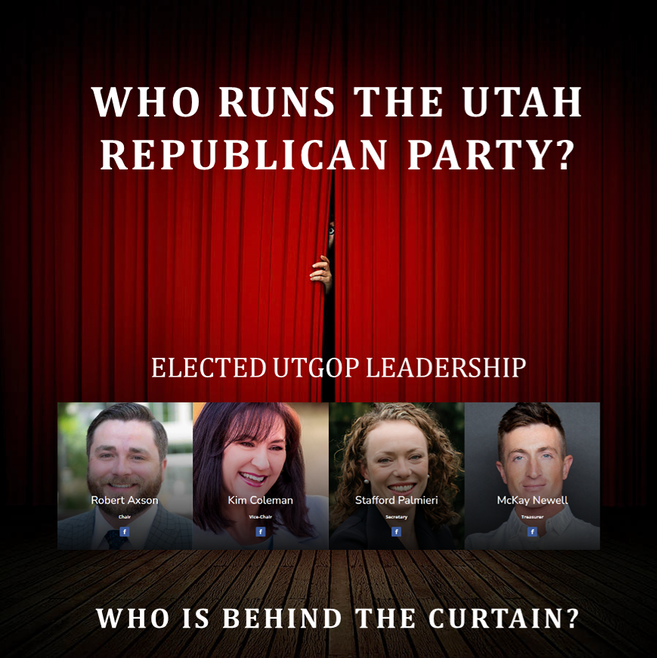
Utah Republican Chair Rob Axson

The Utah Republican Party (URP) Platform provides a clear framework for restoring the proper role of government as a servant of the people, tasked with protecting God-given, unalienable rights of life, liberty, property, and the pursuit of happiness. Drawing from the principles in the platform, here’s a focused plan for how the URP can take concrete steps to implement this vision within Utah and influence the national stage...BUT IT WILL REQUIRE REAL LEADERSHIP!

Enforce Constitutional Limits Through State Legislation
The URP Platform emphasizes that “government properly exists by the consent of the governed and must be restrained from intruding into the freedoms of its citizens.” To uphold this, the URP can:
  • Propose a Utah Constitutional Compliance Act: Require all state legislation to include a constitutional justification, ensuring alignment with both the U.S. and Utah Constitutions. This would block laws that expand government beyond its protective role.
  • Audit State Agencies: Create a task force to review agencies like the Utah Department of Health and Human Services for overreach, eliminating programs that redistribute wealth or infringe on liberties without clear constitutional grounding.
  • Lead by Example: Advocate for Utah to model limited government for other states, showcasing fiscal restraint and individual freedom to counter federal overreach.

Read More
0 Comments

EVIL FROM THE WOMB: THE ASSASSINATION OF CHARLIE KIRK AND THE CULTURE THAT PRODUCED IT

9/11/2025

0 Comments

 
Picture
Charlie Kirk — a generational voice of the conservative movement — was assassinated Wednesday while hosting one of his famous campus discussion events.

We may not yet know the shooter’s name, but we do know the deeper cause. Radical leftists bear great blame for engaging in inflammatory rhetoric that amounts to assassination prep. And Republicans bear responsibility, too, for letting it come to this.

Before Kirk died at the hands of an assassin, leftist radicals had already tried to kill Rep. Steve Scalise, President Donald Trump (twice), and Supreme Court Justice Brett Kavanaugh. Each time, Republicans condemned the violence, but then moved on. Each time, the left learned they could push further without consequence.

Mike Cernovich put it bluntly on X: “The weakness of the GOP led us to this moment. A mass shooter attempted to murder dozens of Republican congress members. Few people even know this happened. Republicans ‘just took it,’ as they always do. And now Charlie Kirk is dead. Recognize what time it is or resign.”

He’s right.

Evil Is Not New

Scripture reminds us that evil is not a modern invention. It is rooted in human nature. “The wicked are estranged from the womb; they go astray from birth, speaking lies” (Psalm 58:3).

This is more than poetry. It describes reality: sin and evil take root early, and when they are unchecked, they manifest in hatred, lies, and violence.

Today we see that reality in politics. The radical left does not merely disagree with conservatives. It dehumanizes us. It conditions followers to believe that Republicans are so vile, they deserve elimination. Once you cast people as subhuman, it is only a matter of time before assassins emerge.

Read More
0 Comments

RESTORING STATE SOVEREIGNTY: A CONSTITUTIONAL CASE FOR TRANSFERRING FEDERAL LANDS TO UTAH

7/4/2025

0 Comments

 
Picture
Utah Senator Mike Lee said: "I continue to believe the federal government owns far too much land – land it is mismanaging and in many cases ruining for the next generation," Lee wrote. "Under Democratic presidents, massive swaths of the West are being locked away from the people who live there, with no meaningful recourse."

From our Utah Republican Party Platform Plank: UTAH STATE SOVEREIGNTY

The 13 original Sovereign States in Constitutional Convention created the Constitution of the United States of America and subsequently ratified that document creating a Federal Government and granting to that Government limited and enumerated powers.

The Tenth Amendment to the Constitution of the United States defines Federal powers as those enumerated in the Constitution and reserves all other powers to the States and to the People.

It remains the sacred responsibility of the States as creators of the Federal Government to keep the federal powers within the limits set by the Constitution.
We resolve that the Republican Party of the Great State of Utah and elected party members take any and all steps necessary to ensure that Federal powers exercised within the Great State of Utah not exceed those granted by the Constitution of the United States, and that those usurpations of State Sovereign Powers already violated by the Federal Government be corrected by the State Legislature and enforced by the Governor’s office thus protecting Utah State Sovereignty.

This is my Constitutional argument for Utah gaining greater control over our federal lands.

Introduction

The federal government owns nearly two-thirds of Utah’s landmass. This level of federal control is not only economically harmful and socially disruptive, but it also raises serious constitutional questions about state sovereignty, federalism, and the intent of the Founders.

While past court rulings have upheld expansive federal land ownership, it’s time to reexamine this issue in light of original constitutional principles and Utah’s unique enabling history.

The Equal Footing Doctrine

The U.S. Constitution requires that all new states be admitted on an “equal footing” with the original states.

Yet Utah, like many Western states, was admitted with the understanding that it would eventually gain control over its public lands—just as Eastern states did following statehood. The fact that the federal government owns less than 5% of land in most Eastern states, but over 60% in Utah, creates a glaring violation of this principle of equal sovereignty.

Legal Precedent to Challenge: The courts have narrowly defined the Equal Footing Doctrine in past land cases, but new evidence and modern constitutional scholarship could justify revisiting the issue, especially with a more federalist-oriented judiciary.

Promises Made in the Utah Enabling Act

Utah’s 1894 Enabling Act, which set the terms for Utah’s statehood, contains language suggesting that the federal government would eventually dispose of its lands, not hold them in perpetuity.

The Act says: “That the people inhabiting said proposed State do agree and declare that they forever disclaim all right and title to the unappropriated public lands lying within the boundaries thereof…until the title thereto shall have been extinguished by the United States.”

The clear expectation was eventual disposal of federal land, not indefinite federal ownership. Utah kept its side of the bargain by disclaiming ownership temporarily, pending federal disposition. Now, over a century later, the federal government has failed to fulfill its part.

The Tenth Amendment and State Sovereignty

The Tenth Amendment reserves to the states all powers not delegated to the federal government. There is no constitutional provision that mandates or authorizes the federal government to permanently retain vast portions of land within state boundaries.

Proponents of federal control point to the Property Clause (Article IV, Section 3), but this clause was intended to manage lands during the nation’s territorial period—not to justify permanent federal occupation of sovereign state territory.

Originalist and Textualist View: Modern overreach in land retention stretches the Property Clause far beyond its original meaning, violating the balance of power between federal and state governments.

Economic Harm and Federal Overreach

Utah’s economy, housing affordability, resource development, and local tax base are all constrained by federal land hoarding.

Consequences of current federal land policy include:
  • Lost revenue from taxable land
  • Restricted energy and mineral development
  • Overregulation of grazing, water rights, and recreation
  • Federal land management decisions made by bureaucrats with no local accountability


Constitutionally, when federal land policies infringe upon a state’s ability to govern itself and serve its citizens, federalism is undermined.
 
A Call for Legal and Legislative Action

Utah and its sister Western states should:
  • Pursue new litigation: Challenge the constitutionality of indefinite federal land retention using modern originalist interpretations.
  • Seek Congressional redress: Advocate for legislation to require large-scale federal land transfers back to the states.
  • Mobilize public opinion: Highlight how current federal land ownership harms state sovereignty, economic growth, and individual property rights.

Conclusion

The constitutional question is not simply what the courts have ruled in the past. It is whether the current federal stranglehold on Utah lands aligns with the letter, spirit, and original intent of the U.S. Constitution.

Utah deserves the same rights, sovereignty, and land ownership opportunities that the original 13 states—and most Eastern states—have enjoyed for over two centuries.

It’s time to finish the job of statehood—and return Utah’s lands to Utahns. GET ON IT ATTORNEY GENERAL BROWN!

​By BillyO
0 Comments

MEET BILL OLSON: A VISION FOR WEBER COUNTY'S REPUBLICAN FUTURE

4/5/2025

0 Comments

 
Picture
Podcast
Picture
Politic-it Host Senator John Johnson with Bill Olson

​In this Politic-it Podcast episode, we sit down with Bill Olson, candidate for Weber County Republican Treasurer. Bill shares his extensive business experience and his passion for community service while emphasizing leadership, open dialogue, and the importance of adhering to party principles and governing rules to unify the Republican Party. 
A Journey Through Time
Bill Olson’s journey is a fascinating one, marked by pivotal moments that shaped his understanding of politics and community service. Growing up in the 60's and 70s, he faced the complexities of a tumultuous era. The Vietnam War and its associated uncertainties left a lasting impression on him, emphasizing the need for integrity in government.
PictureBill Olson
Meet Bill Olson 
With over 45 years of entrepreneurial experience, Bill has successfully launched and managed businesses across multiple industries. He has authored several business plans, co-founded companies, raised capital, and played key roles in business development. Currently, he serves on the board of a privately held corporation and provides consulting on management and governance.
​

Beyond business, Bill has been deeply engaged in civic involvement, offering education and training to elected volunteers within the Republican Party. His dedication to leadership and community service makes him a strong candidate for the role.

​Bill Olson: A Candidate’s Background
Bill Olson is not just a candidate; he embodies the spirit of the community he aims to serve. His roots run deep in Weber County, where he has been an active participant in local politics for over two decades. His experiences have provided him with a unique perspective on the needs and aspirations of the community.

Educational Foundations: Loyola Marymount University
Bill’s educational journey began at Loyola Marymount University, where he pursued political science and philosophy. This institution, known for its rigorous academic standards and Jesuit values, played a crucial role in shaping his worldview. The small class sizes allowed for personalized learning, fostering critical thinking and debate.
Picture
Registering students to vote at LMU for the 1976 Presidential election. (That's Bill as Uncle Sam).
The Art of Communication
Bill has always been a natural communicator. His early experiences, from leading voter registration drives while serving as president of the Political Science Association, honed his skills. He believes that effective communication is key to motivating others and driving political change.

Political Influences and Early Mentorship
Influenced by major political figures, Bill found inspiration in Ronald Reagan, who represented a shift in the political landscape. His early involvement in campaigns, even for opposing parties, provided him with valuable insights into the political process. This diverse exposure has deeply informed his principles and approach to politics.
Picture
In Studio
Navigating the Political Landscape
Understanding the political landscape is essential for anyone involved in local governance. Bill Olson emphasizes that the role of the party is to elect quality candidates who align with the party’s platform. This platform serves as a guiding document, helping voters predict candidate behavior. When candidates stray from this platform, it can confuse and frustrate voters, leading to discontent within the party.
​
Personal Values and Beliefs
Bill’s personal values are deeply rooted in his experiences and upbringing. His commitment to integrity and truth is paramount. He believes that personal covenants with God are essential, and that these convictions guide his political actions. Bill’s approach is driven by a desire to do the right thing, even when faced with challenges or differing opinions.
Picture
Business Experience and Political Insights
Bill’s extensive business background has shaped his approach to politics. Having started multiple companies, he understands the importance of effective leadership and accountability. His experience in hiring and managing teams has taught him how to identify and cultivate talent, skills he believes are crucial for party leadership. However, he acknowledges the unique challenges faced in a volunteer-based organization, where the same level of accountability isn’t always possible.
​
Establishing Weber County Conservatives
In 2017, Bill founded Weber County Conservatives to address educational gaps within the party. His initiative aimed to provide training for volunteers and elected officials, enhancing their understanding of party governance. He recognized that many newcomers felt overwhelmed and unprepared at state conventions, and he wanted to change that. By creating a structured training program, he hopes to empower individuals to become effective advocates for conservative values.
Picture
Motivating Party Members
Motivation is a key aspect of Bill’s strategy for engaging party members. He believes in fostering a culture of learning and accountability. By encouraging individuals to read and understand the party’s governing documents, Bill aims to create a more informed and active membership. His commitment to open dialogue and debate is intended to ensure that every voice is heard and valued, even if opinions differ.
​
The Role of the Republican Party
Bill asserts that the Republican Party must remain true to its foundational principles. He believes that the party’s role is not just to win elections but to uphold the values outlined in its platform. This consistency is vital for maintaining voter trust and engagement. Bill emphasizes the need for constructive debate within the party, allowing for healthy disagreement while still striving for consensus.
Picture
Host of Politic-it Senator John Johnson
Challenges Facing the Party
The Republican Party faces numerous challenges that threaten its unity and effectiveness. One major issue is the growing divide between traditional conservatives and those who lean towards more extreme views. This fragmentation can lead to confusion among voters and diminish the party’s overall impact.

Additionally, external factors such as changing demographics and shifting public opinions on key issues complicate the party’s strategy. To remain relevant, the party must address these challenges head-on while maintaining its core principles.
​
Managing Change Within the Party
Change is inevitable, especially in a political landscape that is constantly evolving. Effective leadership within the party is crucial for managing this change. Leaders must facilitate open discussions about the party’s direction and be willing to adapt strategies based on the needs of their constituents.
​
Building a cohesive team that can navigate these changes requires transparency and collaboration. By involving party members in decision-making processes, leaders can foster a sense of ownership and commitment among the ranks.
Picture
Addressing Factions and Disagreements
Internal factions can pose significant challenges for the party. These divisions often stem from differing priorities and interpretations of core values. It’s essential to recognize that disagreement is not inherently negative; it can lead to constructive dialogue and stronger policies.
​
To effectively address these factions, the party should create forums for discussion where all voices are heard. Encouraging respectful debate can help unify members and clarify the party’s stance on various issues.

The Importance of Dialogue
Open dialogue is fundamental to a healthy political environment. It allows members to express their concerns and ideas, fostering a culture of inclusivity. The party must prioritize communication to bridge gaps between differing viewpoints.
​
By establishing regular communication channels, the party can ensure that all members feel valued and heard. This approach not only strengthens relationships within the party but also enhances its overall effectiveness in reaching out to voters.
Picture
Final Thoughts and Call to Action
The future of the Republican Party depends on its ability to adapt, unite, and engage its members. By addressing internal challenges and fostering a culture of open dialogue, the party can reclaim its position as a leading force in American politics.

As a call to action, I encourage all party members to actively participate in discussions and contribute their ideas. Together, we can build a stronger, more effective Republican Party that truly represents the values and interests of its constituents.

Produced by Johnson Media
Picture
Kevin Johnson
Picture
Scan for the Podcast
Picture
​

​​soundcloud.com/user-92511303/stand-for-something
​soundcloud.com/user-92511303/bills-holding-on​
0 Comments

"PURSUANT TO EXECUTIVE AUTHORITY..." UNWINDING THE DEEP STATE

2/7/2025

0 Comments

 
​OVERRIDE
​

INSIDE THE REVOLUTION REWIRING AMERICAN POWER
Picture
The clock struck 2 AM on Jan 21, 2025.
​

In Treasury's basement, fluorescent lights hummed above four young coders. Their screens cast blue light across government-issue desks, illuminating energy drink cans and agency badges. As their algorithms crawled through decades of payment data, one number kept growing: $17 billion in redundant programs. And counting.
"We're in," Akash Bobba messaged the team. "All of it."

Edward Coristine's code had already mapped three subsystems. Luke Farritor's algorithms were tracing payment flows across agencies. Ethan Shaotran's analysis revealed patterns that career officials didn't even know existed. By dawn, they would understand more about Treasury's operations than people who had worked there for decades.

This wasn't a hack. This wasn't a breach. This was authorized disruption.
Picture
​While career bureaucrats prepared orientation packets and welcome memos, DOGE's team was already deep inside the payment systems. No committees. No approvals. No red tape. Just four coders with unprecedented access and algorithms ready to run.

"The beautiful thing about payment systems," noted a transition official watching their screens, "is that they don't lie. You can spin policy all day long, but money leaves a trail."

That trail led to staggering discoveries. Programs marked as independent revealed coordinated funding streams. Grants labeled as humanitarian aid showed curious detours through complex networks. Black budgets once shrouded in secrecy began to unravel under algorithmic scrutiny.

By 6 AM, Treasury's career officials began arriving for work. They found systems they thought impenetrable already mapped. Networks they believed hidden already exposed. Power structures built over decades revealed in hours.
​
Their traditional defenses—slow-walking decisions, leaking damaging stories, stonewalling requests—proved useless against an opponent moving faster than their systems could react. By the time they drafted their first memo objecting to this breach, three more systems had already been mapped.
Picture
"Pull this thread," a senior official warned, watching patterns emerge across DOGE's screens, "and the whole sweater unravels."

He wasn't wrong. But he misunderstood something crucial: That was exactly the point.

This wasn't just another transition. This wasn't just another reform effort. This was the start of something unprecedented: a revolution powered by preparation, presidential will, and technological precision.

The storm had arrived. And Treasury was just the beginning.

THE FOUNDATION
"Personnel is policy."

For decades, this principle, articulated by conservative strategist Troup Hemenway, remained more theory than practice. Previous administrations spent months, even years, trying to staff key positions. Trump's first term saw barely 100 political appointees confirmed by February 2017.

Every delay meant another victory for the permanent bureaucracy.
But this time was different.

While media focused on campaign rallies and political theater, a quiet army was being assembled. In offices across DC, veteran strategists mapped the administrative state's pressure points. Think tanks developed action plans for every agency. Policy institutes trained rapid deployment teams. Former appointees shared battlefield intelligence from previous administrations' failures.

By Inauguration Day, over 1,000 pre-vetted personnel stood ready—each armed with clear objectives, mapped legal authorities, and direct lines to support networks. This wasn't just staffing; it was a battle plan decades in the making.
​
"This is the new normal," Vice President JD Vance declared from his West Wing office, studying real-time data flows across agency systems. "He's having the time of his life," he added, referring to the President's relentless drive. "We've done more in two weeks than others did in years."

Read More
0 Comments

HOW BARACK OBAMA BUILT AN OMNIPOTENT THOUGHT-MACHINE, AND HOW IT WAS DESTROYED.

1/1/2025

0 Comments

 
By David Samuels
Picture
During the Trump years, Obama used the tools of the digital age to craft an entirely new type of power center for himself, one that revolved around his unique position as the titular, though pointedly never-named, head of a Democratic Party that he succeeded in refashioning in his own image.

If anyone in the future cares enough to write an authentic history of the 2024 presidential campaign, they might begin by noting that American politics exists downstream of American culture, which is a deep and broad river. Like any river, American culture follows a particular path, which has been reconfigured at key moments by new technologies. In turn, these technologies, which redefine both space and time—canals and lakes, the postal system, the telegraph, railroads, radio and later television, the internet, and most recently the networking of billions of people in real time on social media platforms—set the rules by which stories are communicated, audiences are configured, and individuals define themselves.

Something big changed sometime after the year 2000 in the way we communicated with each other, and the means by which we absorbed new information and formed a working picture of the world around us. What changed can be understood as the effect of the ongoing transition from the world of 20th-century media to our current digital landscape. This once-every-five-centuries revolution would have large effects, ones we have only just begun to assimilate, and which have largely rendered the assumptions and accompanying social forms of the past century obsolete, even as tens of millions of people, including many who imagine themselves to reside near the top of the country’s social and intellectual pyramids, continue to imagine themselves to be living in one version or another of the long 20th century that began with the advent of a different set of mass communications technologies, which included the telegraph, radio, and film.

The time was ripe, in other words, for a cultural revolution—which would, according to the established patterns of American history, in turn generate a political one.

Read More
0 Comments

MERRICK GARLAND IS THE WORST ATTORNEY GENERAL IN AMERICAN HISTORY

12/10/2024

0 Comments

 
Picture
Even Joe Biden, who nominated Garland, appears to have caught onto the fact that Garland’s DOJ is infected with partisan corruption

For once, left and right agree: Merrick Garland is the worst.

I was surprised when I first saw this article from MSNBC and CNN contributor Dean Obeidallah declaring Garland to be “America’s Worst Attorney General.” Had it finally dawned on someone in our corporate press that smearing parents as “domestic terrorists” and prosecuting political opponents of no less stature than a president might have been a bad idea? (No, it hadn’t.)

The failure for which Garland deserves infamy, according to Obeidallah, was not trying hard enough to throw his boss’s presidential opponent in prison. For that insufficient zeal, he says Garland is “the biggest failure of an attorney general in our lifetimes.”

Even Joe Biden, who nominated Garland, appears to have caught onto the fact that Garland’s DOJ is infected with partisan corruption. Biden accused Garland’s department of having “singled out” certain targets for prosecution based on political reasons, and then “selectively, and unfairly, prosecuted” them and “treated [them] differently” than other defendants.

“Raw politics has infected this process,” Biden wrote last Sunday in a letter absolving his son of any federal crimes he might have committed over the past decade. (What an awkward end for Garland, after all he’s done to protect the Bidens!)

Read More
0 Comments

THE MOB HAS NOTHING ON JOE

12/5/2024

0 Comments


He Can Bury The Bodies With The Stroke Of A Pen

Picture

In organized crime, if you are worrying about the feds turning a key witness against you things can get messy. You may have to “whack” the guy and then deal with all that unpleasant disposing of the body stuff. At the very least it involves a late-night drive to Jersey and a lot of shovels.

What the Mob wouldn’t give for the ability to make a witness useless to the prosecution by putting him legally off limits. That’s what Joe Biden just did with his pardon of his son Hunter Biden. He took the one guy on the planet who could finish him off the table forever.

The press coverage of Joe’s pardon of Hunter has largely presented this as a matter of Joe protecting Hunter from the impending consequences of his conviction on federal charges. That has nothing to do with anything. This isn’t about Hunter at all. It is about Joe, and it is about espionage.

Read More
0 Comments

2-WAY RADIO RANGE: HOW FAR CAN TWO-WAY RADIOS COMMUNICATE

10/10/2024

0 Comments

 
Picture

​www.intercomsonline.com/2-way-radio-range-how-far-can-two-way-radios-communicate
One of the most common questions people ask when they are in the market for a two-way radio or wireless intercom is how far do they communicate? Unfortunately asking this question is along the lines of asking, "How far is up?". There are lots of variables involved and no easy, definitive answer. A brief lesson on radio signal transmission is required to understand the whole range issue.

If you are old enough to remember when AM radio was popular you may remember listening to radio stations that were hundreds of miles away. For frequencies like these below 2 Megahertz (MHz), these signals follow the Earth's curvature because they are reflected off the atmosphere. So AM radio signals in low-noise environments can be received by radios that are way below the horizon hundreds of miles away.
Picture
The two-way radios and intercoms available for you to purchase usually fall in the frequency range of 150MHz to 900MHz (this covers our 151.7MHz channel and 448.6MHz Ogden Repeater channel). Unlike the AM radio waves, radio waves in these frequencies travel in straight lines and as a general rule cannot travel over the horizon or behind solid obstacles.
​
But as in all general rules, there are exceptions to the rules. Even though these frequencies travel via "line-of-sight" paths, radio signals can travel through many non-metallic objects and be picked up through walls or other obstructions. Even though we can't see between antennas of a transmitter and receiver, this is still considered line-of-sight to the radios. Also, radio waves can be reflected, or bounce off surfaces so the straight line between radios, may not always be so straight.
​
Knowing that our radio waves travel in straight lines, then to figure out their maximum range for a two way radio we have to factor in the curvature of the Earth. When you stand on Earth and press the talk button on your radio, the radio waves are going straight and they will eventually just go straight off into space once they pass the horizon. So the distance of the horizon is technically the maximum communication range for a two way radio. But you have to factor in antenna height as well.
Picture

Read More
0 Comments

UTAH'S LT. GOVERNOR AND REPUBLICAN PARTY LEADERSHIP ARE ACCUSED OF CERTIFYING A CONTERFIET BALLOT FOR GOVERNOR!

9/21/2024

0 Comments

 
Picture
NOTICE TO ALL MEMBERS OF THE REPUBLICAN STATE CENTRAL COMMITTEE

​There has been a Notice of Intent to File a Claim provided to the Republican Party Chair. This means the Party has time to correct this act of omission, or be sued.

The claim is directed against members of the State Central Committee and State Party Officers, who have persistently disregarded our Party Constitution and failed to demand the correction of mistakes in direct violation of party members and Claimant’s First and Fourteenth Amendment rights.

Background


The Utah Republican Party held an indirect primary (their Convention) on April 27, 2024. Elected delegates voted for Republican candidates for various state and federal offices. Some candidates, including Phil Lyman, received over 60% of the delegate votes cast. Candidates seeking the Republican nomination in the Party's indirect primary receiving more than 60% of the delegate vote become the nominee at convention and are to be included in the general election ballot certification per the Utah Republican Constitution. 

A qualified political party that nominates a candidate in their indirect primary, must certify the name of the candidate and the appropriate ballot (primary or general) to the lieutenant governor before…” 5:00 p.m. on April 29, 2024. The State Party Chair serving as "liaison with the Lieutenant Governor of the State of Utah on all matters relating to state election laws," provides the ballot certification to the Lieutenant Governor subject to the directives of the State Central Committee, the governing body of the Party. 

It is important to note here, the Lt Governor serves as the 
chief election officer whose main responsibility is to oversee elections. Pursuant to Utah Code, the lieutenant governor is to perform ministerial duties (without judgement) and place those candidates certified to the appropriate ballots as instructed by the Utah Republican Party. So, either the Utah Republican Party Chair submitted a proper ballot to the Lt Governor (LYMAN STRAIGHT TO THE GENERAL based on the Party’s constitution) and the Lt Governor submitted a counterfeit ballot to the state…because it was in her best interest to do so...or the Party Chair submitted a counterfeit ballot to the Lt Governor and she played along because again, it was in her best interest to do so. In either case, one is guilty and the other is stupid! Or together they conspired to violate the Party’s 1st and 14th Amendment rights. And as the governing body of the party, it is your duty to see that the rules are carried out accordingly. If laws were broken, you as a State Central Committee member have personal liability if it is not corrected. 
 
With respect to the SCC, each member is elected by their membership to represent the interests of their constituents. They have a duty, in business we call it a fiduciary duty. It means you have an obligation to act in the best interest of those you represent. The SCC has been properly noticed of this constitutional violation, and any inaction on their part is a violation of their fiduciary duty. 
Whether their negligence is civil or criminal, it is a gross dereliction of their duty to withhold the proper exercise of their responsibility, to see that the Party’s laws are faithfully executed!

​By BillyO

​Below find the Actual Notice of Intent to File a Claim with appropriate citations...

Read More
0 Comments

THE UTGOP MUST SAVE ITSELF FROM DESTRUCTION...AND HAS THE CONSTITUTIONAL AUTHORITY TO DO SO!

9/1/2024

6 Comments

 
Picture
For years in Utah, democrats have joined the Republican Party in order to get elected. This is possible because the UTGOP has been complacent in allowing membership in the Party simply by declaring it so. While this created challenges for voters to understand who the real Republican is, the Caucus/Convention system provided the locally elected delegates the final say in who indeed could represent the Party on the primary or general election ballot. In most cases, Democrats who declared themselves Republicans found out they could not pass the scrutiny of the well-informed delegates. So, they had to change the rules and provide an alternate path to the Republican ballot in order to get elected...Meet Count My Vote! 

According to SB54, “whenever there is at least one candidate chosen by convention and at least one who gained candidacy for the same office by collecting signatures, a qualified political party must participate in a primary election to choose between them.” If a party’s only candidates for an office are chosen at its convention, the party “is not required to participate in the primary election for that office.” For qualified political parties then, the requirement to participate in the primary only exists when the signature-gathering path to nomination is used by “declared republican” candidates outside of the Convention process. “A State cannot substitute its judgment for that of the party as to the desirability of a particular internal party structure.” The Party is a private constitutionally protected institution.
 
When a qualified political party only has candidates who emerged from its convention, the law does not require the party to participate in a primary. If Party members want a signature-gathering route to nomination outside the convention process, they can surely rally for that change to the Party’s bylaws, and if a cabal tried but failed to truly shut out the voices of ordinary members, they are free to quit, to form a new party, or to cast their votes elsewhere. It is none of the state’s business. 

Read More
6 Comments

MY 2024 REPUBLICAN PARTY STATE CONVENTION REPORT

4/28/2024

7 Comments

 
Picture
ONE FOR ALL...ALL FOR ONE! 
The Utah Republican Party State Convention: Saturday, April 27, 2024 
​

My Convention Report 
Bill Olson NOG12 
Weber County 
_______________________________________________   

​After spending an hour and a half in line to register as a delegate, I entered the convention hall to find a seat. The hall was full of delegates of which almost half raised their hands as first-time delegates. Shortly after the prayer, pledge of allegiance, approval of the rules and the agenda we got started. I was standing at the microphone waiting for my turn as a delegate to gain the floor as a member of our deliberative assembly represented by all 29 counties in Utah.

As a deliberative assembly, our state delegates meet at our state convention to determine, in full and free discussion, the election of our state candidates and courses of action to be taken by our Party. To hold more efficient meetings and respect the opinion of each member, we adhere to the rules of parliamentary procedure. We are there to exhaust all debate before any vote is taken or decisions are made. Debate cannot be exhausted if it is restrained and that is what happened here today.  

Prior to the Convention there were many of us delegates concerned about the direction of the Party and its leadership. Since the success of SB 54 our caucus/convention system has been essentially neutered. This unconstitutional legislation forced on the Party by big money interests has created a path to getting their candidates elected without the hassle of delegate scrutiny or Party endorsement.  

With the deterioration of election integrity over the last few election cycles, many in the Party have related concerns about the method of elections at our Convention. The State Central Committee (SCC) is the Policy making body of the Party. Members are elected by every county; these committee members operate as the legislative branch of the Party with the responsibility of governing the Party as a deliberative assembly. That means they make the rules by majority or in some cases a super majority using Roberts Rules of Order. Roberts Rules allows for the majority to rule while acknowledging the rights of the minority.  Under these rules, the SCC determines how the Party business is conducted.  

Read More
7 Comments
<<Previous

    Author

    Bill Olson 
    I Studied Political Science, Philosophy, Constitutional Law and International Relations (Politics of Oil) at Loyola Marymount University in Los Angeles, CA. Today, I am a retired entrepreneurial executive with more than 45 years’ experience in business start-up and development across multiple industries. I have authored several successful business plans while co-founding, raising capital and managing companies in diverse markets including Professional Sports (Golf), High-tech Database Development, Direct Marketing & Fulfillment, Waste Heat  Recovery for Power Generation and  Molecular Diagnostics for Animal, Plant & Human applications. I currently sit on the Board of a privately held corporation and consult on management and governance issues. 

    As a member of the Weber County Republican Party, I have been a County and State delegate, Precinct Chair and Vice Chair, Legislative District Chair and Vice Chair,  served on the County Central Committee, County Executive Committee, the State Central Committee, and Chaired a Sub-committee on Ethics for the State Executive Committee. I am conservative, well read and active in political debate.

    Archives

    January 2026
    December 2025
    November 2025
    October 2025
    September 2025
    July 2025
    April 2025
    February 2025
    January 2025
    December 2024
    October 2024
    September 2024
    April 2024
    March 2024
    February 2024
    January 2024
    December 2023
    November 2023
    October 2023
    September 2023
    August 2023
    July 2023
    June 2023
    May 2023
    April 2023
    March 2023
    February 2023
    January 2023
    October 2022
    September 2022
    March 2022
    February 2022
    January 2022
    December 2021
    November 2021
    October 2021
    February 2019
    February 2018
    January 2017

    RSS Feed

    Categories

    All
    Constitutional
    Covid 19
    Covid Testing
    Energy
    Ethics
    GOP Principles
    Harden The Grid
    Holidays
    Politics

We Would Love to Have You Back Again Soon!


Picture
  • Home
  • About Us
  • Caucus 2026
  • Precinct Chair Duties
  • Billy O's Blog
  • REPUBLICAN PARTY AUTONOMY
  • ​Honesty in Membership
  • Patriot Training
  • SCC Review
  • CCC Training
  • SB 54
  • WEBER PRECINCTS TOWNHALL
  • THE FREEDOM CAUCUS
  • ERIC and the vote
  • Paper Ballots Now
  • The Brandenburg Files
  • HOW TO SURVIVE AN EMP ATTACK
  • Reading Room
  • Training Videos
    • REPUBLICAN PARTY PLATFORM Video
    • County Delegate Training Video
  • Contact Us